

Introduction
One of the principles underpinned under Article 3 of the United Nations Framework Convention on Climate change “The Convention” is that Parties should protect the climate system for the benefit of present and future generations of humankind, on the basis of equity and in accordance with their common but differentiated responsibilities and respective capabilities. The words “…in accordance with their common but differentiated responsibilities and respective capabilities” means that while all countries share a collective duty to address climate change, they are not expected to financially contribute equally in the same way or to the same extent.
This principle reinforces why climate financing is essential in global climate governance. This is because countries have different historical contributions to emissions and varying levels of economic and technological capacity and thus financial obligations must also be differentiated to reflect these realities. The Convention facilitates the provision of climate finance by establishing financial mechanisms under Article 11 to provide financial resources to address climate change. The financial mechanisms are operated by a designated entity or entities under the guidance of the Conference of the Parties(COP).
It is through this Convention that during the COP 16, in 2010, Parties to the Convention established the Green Climate Fund (GCF) and in 2011 designated it as an operating entity of the financial mechanism.
Green Climate Fund
The Green Climate Fund (GCF) is a global fund created to support the efforts of developing countries to respond to the challenge of climate change through assisting the countries to limit or reduce their greenhouse gas (GHG) emissions and adapt to climate change. One of the principles of the Fund is to pursue a Country-driven approach whereby developing countries lead GCF programmes and their implementation. To achieve this, the fund resolved to only consider funding proposals that are submitted with a formal letter of No Objection from the Countries’ National Designated Authority (NDA)/Focal Point. The purpose as per the Initial No-objection Procedure is to ensure consistency with national climate strategies and plans and country-driven approaches and to provide for effective direct and indirect public and private sector financing by the Fund.
No Objection Procedure – Kenya
The National Treasury through Circular No.2/2026 has published guidelines on issuance of a No Objection Letter (NOL) for funding proposals to the GCF. The guidelines apply to all projects/activities being implemented in Kenya and can be summarized as follows:-
- National Designated Authority (NDA)and Focal Points
The GCF Initial best-practice guidelines for the selection and establishment of national designated authorities and focal points provides that Countries may establish an NDA to interact with the fund. It further mandates that the NDA or focal point should likely be placed within a ministry or authority conversant with the country’s national budget, economic policies and their interrelation with climate change priorities and development plans.
Based on this, Kenya has designated the National Treasury as the NDA to the GCF and the Principal Secretary for the National Treasury as the primary focal person for the NDA. The guidelines also establish an Inter-Ministerial Technical Committee (IMTC) on Climate Finance which shall support and provide leadership on climate finance activities in Kenya including the GCF. The Committee shall be composed of senior technical officers handling climate change and climate finance matters from the relevant Ministries, Departments, Agencies, Council of Governors, and representatives from private sector and Civil Society Organizations. Key responsibilities for the NDA include:-
- Providing strategic oversight by aligning GCF activities with national development and climate priorities
- Facilitate Stakeholder Coordination
- Implementing processes to approve projects/programmes and grant NOL for projects/programmes
- Nominating entities for accreditation
- Spearheading the deployment of readiness and preparatory support funding in the country
- General Guidelines
Proposed projects/programmes that intend to be funded under GCF should be guided by the following:-
- The proposed project/programme should be aligned with national priorities including Kenya’s Vision 2030 and Kenya’s Climate Laws, Regulations, policies and plans thus ensuring that the proposed projects are legally compliant, sustainable and meet national development needs with regard to climate adaptation and mitigation.
- The project should be endorsed by the relevant national or county government entities or beneficiaries
- It ensures that projects fit within local government planning, budgeting and development goals thus ensuring long-term sustainability and legitimacy.
- Conduct comprehensive stakeholder engagement for the project/programme
- Stakeholder engagement ensures that all persons likely to be affected by the project/programme actively participate and are included in the decision making process through provision of necessary information for them to make informed decisions for or against the project.
- The proposed project/programme should aim to enhance locally led priority actions
- Projects must aim to strengthen and scale up solutions already identified and led by local communities. The enhancement can be through financial resources, capacity building or technical support thus making the locally led solutions effective and sustainable.
- Projects/programmes proposed by International or Regional Accredited entities must demonstrate access to resources that Direct Access Entities cannot access. (Direct Access entities in this case are sub-national, national or regional institutions that can access GCF funding directly, without needing to go through international intermediaries)
- This ensures that large international entities do not take funding for projects that local institutions are already capable of handling. It also acts as a way of encouraging partnerships between local entities and regional and international entities in order to execute large-scale complex projects.
- For multi-national projects, Kenya shall consider projects/programmes involving no more than seven (7) participating countries, or in cases where the project demonstrates a clearly articulated value proposition to Kenya, evidenced by a significant allocation of the overall project value towards Kenya-specific investments
- International Accredited Entities such as United Nations agencies, multilateral development banks, international financial institutions and regional institutions should have local partners as executing entities
- This ensures local ownership and alignment with national priorities as projects shall be fit-for-purpose thus ensuring long-term sustainability of the project.
c. Process of obtaining a No Objection Letter
The guidelines provide a step-by-step process which is outlined as follows:-
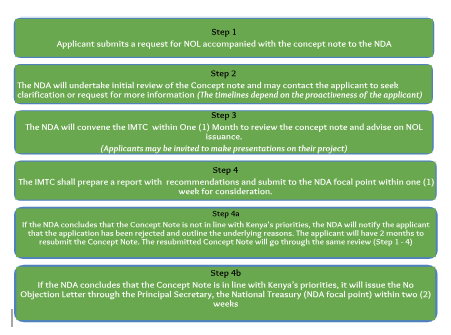
d. Validity of the No Objection Letter (NOL)
A NOL shall be considered invalid if the funding proposal deviates from the original concept note used to issue the NOL. This ensures that the project’s core objectives, scope or location do not change drastically and that substantial changes will require a new NOL. In addition, if the project proponent fails to submit a full funding proposal to GCF within two(2) years of NOL’s issuance the NOL shall be declared invalid.
e. Appeals
If a No Objection Letter is withheld or rejected, an accredited entity may submit a written appeal to the NDA within two(2) months of the decision. The guidelines provide that the appeal must directly address the NDA’s reason for rejection and outline proposed corrective actions.
Conclusion
Kenya’s No Objection Letter Guidelines reflects GCF’s core principle which is to pursue a Country-driven approach whereby developing countries lead GCF programes and their implementation. With a commitment to reduce greenhouse gas emissions by 35% by 2035, the guidelines provide a framework that Kenya can effectively use to strengthen and direct climate finance towards its most urgent adaptation and mitigation needs while ensuring accountability and transparency in projects carried out by public and private sectors.