
When people think about wildlife trafficking, images of ivory tusks, rhino horns or exotic birds often come to mind. Rarely do we imagine ants being at the center of an international smuggling operation. Yet recent events in Kenya have revealed that even the smallest creatures can become targets in the global wildlife trade.
In 2025 and recently in 2026, Kenyan authorities have intercepted persons’ attempting to leave the country with thousands of harvester ants and live queen ants, respectively. To the average observer, ants may seem common and easily replaceable. But in Republic v Nguyen & another [2025] KEMC 85 (KLR), ants were just not common and easily replaceable but were recognized as ecologically important.
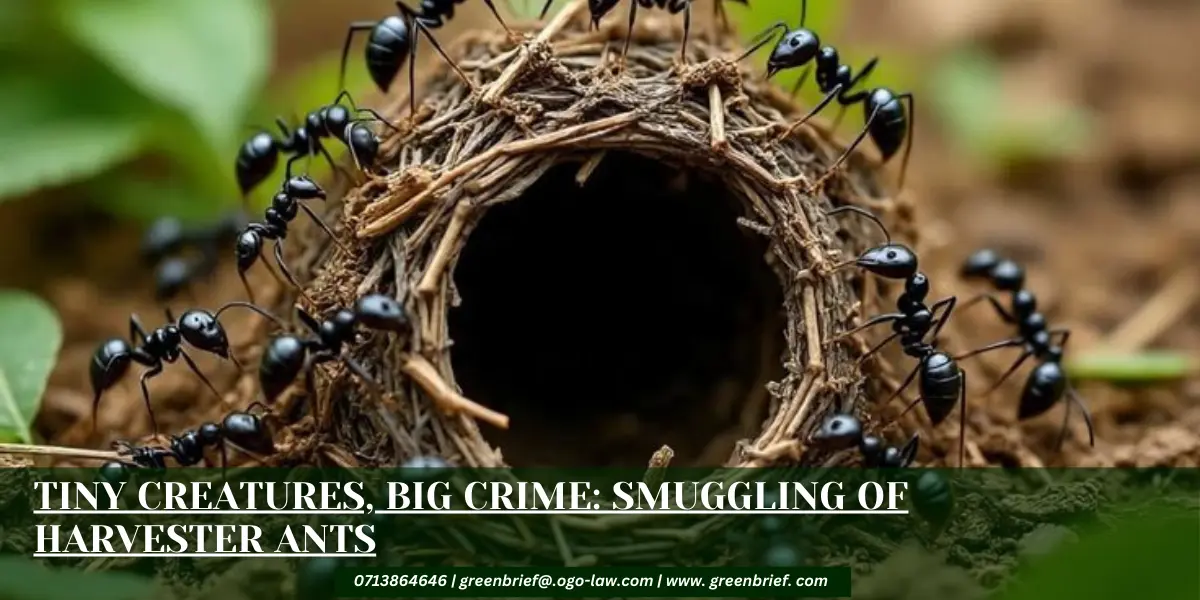
Ever heard of the harvester ants? They are considered to be the largest harvester ants in the world. Their scientific name is Messor Cephalotes and are commonly found in Eastern Africa specifically, Kenya, Tanzania and Ethiopia. They live in colonies and are known for collecting seeds and storing them in their nests for later consumption. They feed on dead insects and other invertebrates. Moreover, they are used to monitor animal behaviour due to their ability to collect and store seeds in an organized and efficient manner. Despite these particular species of ants not being recognized as an endangered species hence needing protection they are considered to be valuable for the ecosystem as their seed-collecting activity helps maintain the balance of vegetation.
Back to the Nguyen & another case, in April 2025, 3 foreign nationals and one kenyan were arrested by the police for being in possession of harvester ants and attempting to smuggle approximately 5,000 live harvester ants out of Kenya. 2 of the arrested persons were arraigned at the JKIA Law Courts and were charged under section 95(c) of the Wildlife Conservation and Management Act Cap. 376 which makes it an offence to deal in live wildlife species without a permit or any exemptions under the Act. They both pleaded guilty to the charges and were sentenced to each pay a fine of one million Kenya Shillings (Kshs. 1,000,000/=) and in default they would each serve 12 months in prison.
The Kenya Wildlife service (KWS) described how the offence had harmed the harvester ants and the public in general, they stated that the reason for the attraction to the said ants was because they were:-
(a) kept as exotic pets;
(b) highly prized for their unique behaviour which is considered therapeutic to watch;
(c) used for research and educational purposes;
(d) a source of research due to their foraging strategies and social structure;
(e) useful in teaching ecology, the behaviour of ants and their importance in the ecosystem; and
(f) helpful in providing insights into biodiversity and the ecosystem.
Additionally, according to KWS, an ant costs approximately 60 – 100 euros. The National Museums of Kenya also outlined the negative effects of mass harvesting and transfer of the harvester ants to include:-
(a) the extinction of the species because of their very “restricted distribution range”;
(b) proliferation of harmful pests such as crop pests due to a lack of predation;
(c) introduction of invasive species in areas where they are not naturally found; and
(d) poor soils, poorly aerated soils and unavailability of nutrients for plants due to disruptions in the process of nutrient recycling.
Importantly, the court noted that trafficking of insects has its history from the 16th century Spanish trade where they would smuggle cochineal insects which produced carmine, a vivid red dye, that was exported through Europe. It also acknowledged that Kenya is signatory to the
Convention on International Trade in Endangered Species of Wild Fauna and Flora (CITES) that regulates a select number of insects and the Nagoya Protocol which provides guidelines for state parties during fair and equitable sharing of benefits arising out of the utilization of genetic resources.
In addition, the court reiterated a publication by the Basel Institute on Governance by Saba Kassa and 3 others in 2019 titled, “Working Paper 30 – Corruption and wildlife trafficking: Exploring drivers, facilitators and networks behind illegal wildlife/ trade in East Africa” which identifies three main drivers of illegal wildlife trade as:-
(a) wealth and status;
(b) trafficking as a victimless crime; and
(c) the morality of appropriating wildlife.
This case serves as a reminder that insects such as Messor Cephalotes continue to hold economic importance to date and that conservation is not just about the big five animals, that is, elephants, rhino, buffalo, lion and leopard but every species including the tiny ants are all part of a vital link in the ecological chain. So the next time you see a colony of harvester ants, no matter how insignificant they may look to you at that very moment, remember someone somewhere values them enough to illegally trade them off for economic gain and how the act of illegally trading of wildlife including Messor Cephalotes is highly likely to be a threat to our shared environment.
Protecting nature requires attention to both the giants of the savannah and the tiny engineers beneath our feet.