

A green economy is an economic model that integrates environmental responsibility with economic growth through investment into economic activities, infrastructure and assets that allow reduced carbon emissions and pollution, promote renewable energy and prevent loss of biodiversity.
Kenya’s public and private sector drive the green economy by investing in renewable energy, promoting sustainable agriculture and climate smart farming, developing green transport systems, conserving and restoring forests, wetlands and other natural ecosystems and creation of green jobs among many others. On the other hand, the government supports this through fiscal incentives such as tax deductions and leveraging its fiscal powers to tax environmentally harmful practices.
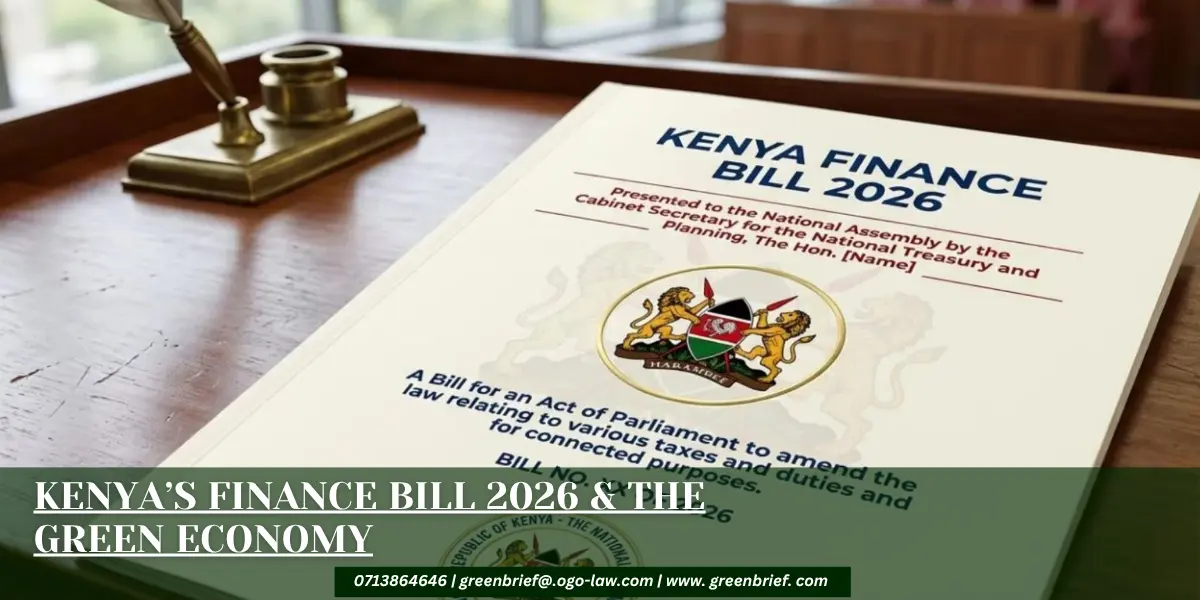
In the upcoming financial year 2026/2027 we take a deep-dive into Kenya’s Finance Bill 2026 and what that looks like for the green economy if the Bill is passed and assented to by the President by 30th June 2026.
A. The tax illusion?
i) Electric buses, bicycles, and motorcycles
The Finance Bill 2026 proposes moving certain goods and services such as supply of electric bicycles, solar batteries, electric buses from zero-rated to VAT Exempt. By transferring a good from Zero-rated to VAT Exempt it means that the supplier of this goods/services shall not be charged VAT and that cost shall be borne by the said supplier. Knowing how business works such costs may not be absolved fully by the supplier and thus shall be passed to the end-users who are consumers.
ii) Animal feeds
Currently, inputs or raw materials locally purchased or imported for the manufacture of animal feeds are zero-rated. In addition, there is no requirement to obtain an approval from the Cabinet Secretary to qualify for the zero-rated status. However, the proposal to change the status from Zero-rated to VAT exempt includes a proposal to obtain a recommendation from the Cabinet Secretary for VAT exemption.
If the Bill is passed, local suppliers would be forced to charge higher prices for the supply of animal feeds to the manufacturers and the manufacturers will pass these costs to the end-users.
At a time where petroleum is at an all time high, these two instances create an impression that no tax is being imposed because the goods/services remain VAT exempt, while in practice, consumers bear the burden through increased costs of transport, clean energy products, livestock feeds and ultimately food prices.
B. Money Transfer Services
For a long time, Payment Service Providers (PSPs) have been exempted from VAT for reasons such as to make the services affordable and for financial inclusion. However, the Finance Bill 2026 seeks to impose a 16% VAT on PSPs as a way of increasing the tax base and generating more revenue. The proposal is as a result of the recent decision by the High Court in Pesapal Limited vs. Commissioner of Domestic Taxes (Income Tax Appeal E081 of 2023) where the Court held that the services of receiving, transferring and processing payments on behalf of third parties or merchants fell within the scope of the VAT exemption.
The proposal, if passed into law, is likely to reverse gains made in the Fintech space and thus act as a threat to financial inclusion and innovation. This will inevitably increase the cost of digital transactions, a burden that is likely to be transferred to consumers and businesses through higher transaction fees. On the other hand, it may discourage the use of digital payment platforms, particularly among low-income earners and Small and Medium Sized Enterprises (SMEs) that rely on affordable electronic payment solutions.
In addition, Fintech solutions also facilitate access to green financing, carbon credit markets and renewable energy payments. Therefore, by increasing the cost of digital transactions, the proposed VAT may slow the adoption of these technologies and hinder the growth of innovative business models that contribute to environmental sustainability and the transition to a greener economy.
C. Scrap Metals
The Finance Bill 2026 proposes to re-introduce a withholding tax of 1.5% for locally sourced and imported scrap metals. This is a welcome move as this may in the long-run formalize the sector and broaden the tax bracket. Over and above this, it is also an opportunity to strengthen the circular economy as it is likely to improve traceability, encourage responsible waste management practices and position Kenya to better align its fiscal policies with its climate action commitments.
The tax implications in the green economy through the proposed Finance Bill 2026 if passed by the National Assembly and assented to by the President, as is, shall determine the viability of sustainability of investments in agriculture and renewable energy, e-mobility affordability and Kenya’s overarching climate transition targets which are set at 35% by 2035 in the financial year 2026/2027.