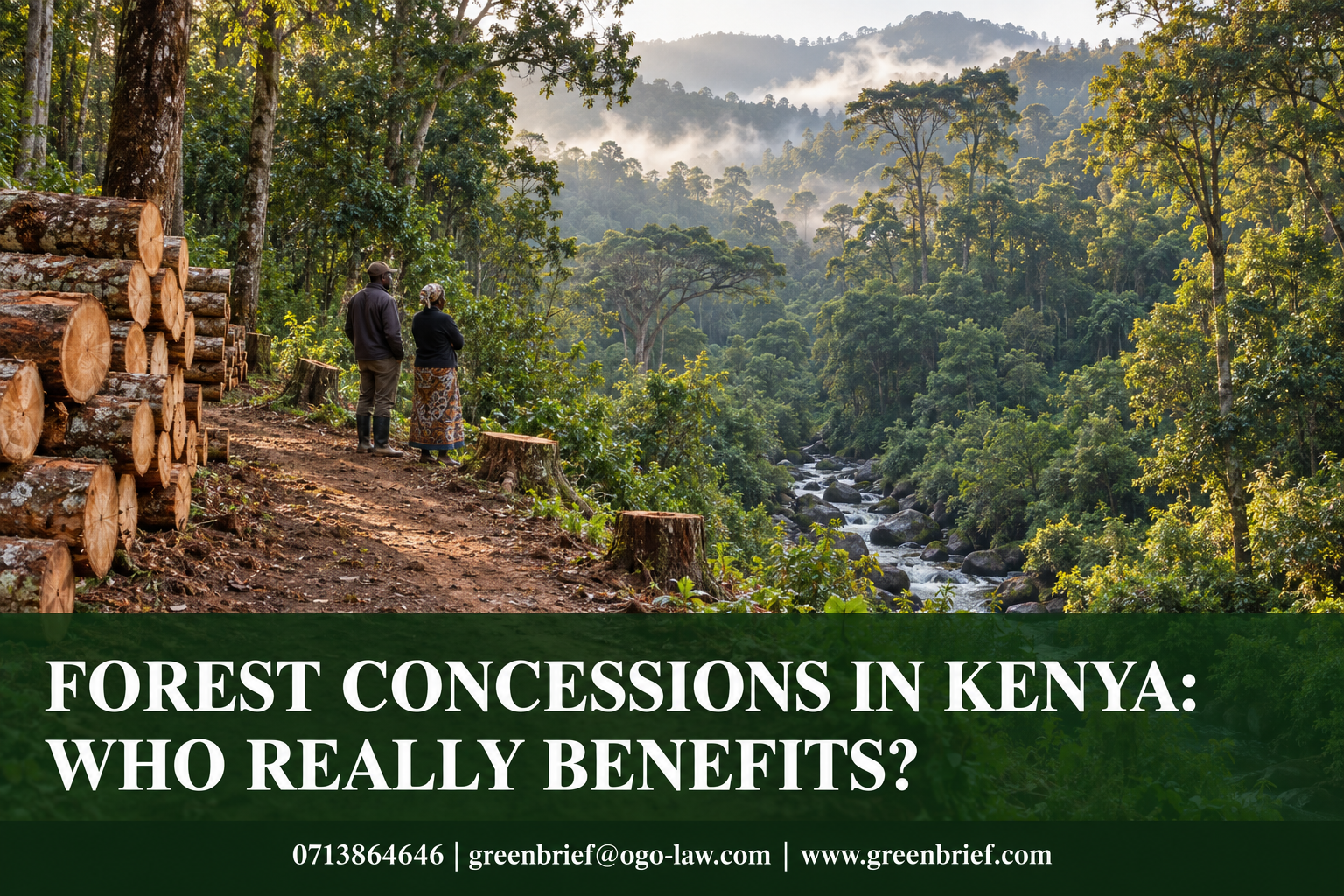

Forest concessions are often presented as a practical way of putting public forests to productive use. The language is familiar: investment, jobs, revenue, timber, tourism and economic development. But a forest is not an empty asset waiting to be allocated. It is a living system connected to rivers, soils, wildlife, climate and communities.
Once a public forest is opened to commercial use, the central question is not simply whether an agreement can be signed. It is whether the arrangement protects the public value of the forest while allowing carefully controlled economic activity.
Under Kenya’s Forest Conservation and Management Act, 2016, a forest concession is a long-term right of use granted to an individual or organisation in a specific area of a national or county forest for commercial forest management and utilisation. This means a concession is not the same as selling a forest or transferring public ownership. It is a conditional authorisation to use or manage a defined area for an agreed purpose.
That distinction matters. A concessionaire does not receive an unrestricted licence to treat the forest as private property. The use must remain subject to the Constitution, the Forest Conservation and Management Act and other applicable laws.
The law also establishes safeguards before a concession can be granted. The Kenya Forest Service must be satisfied that the proposed utilisation is suitable for a concession. The proposal must undergo an independent environmental impact assessment, and public consultation must be completed before the concession is recommended.
The concessionaire must also prepare a forest management plan covering matters such as forest inventories, reforestation or replanting programmes, annual operations, community user rights and community benefits. The concessionaire is required to protect the area from destruction and encroachment, maintain the forest for biodiversity, cultural and recreational purposes, prevent forest fires and comply with applicable management guidelines.
An environmental protection bond is also required. This is intended to provide financial security for the environmental obligations connected to the concession. The law further allows a concession to be withdrawn where its conditions are breached. These provisions show that a concession is meant to be an accountable management arrangement, not a permanent entitlement.
The constitutional framework strengthens this position. Article 42 of the Constitution of Kenya, 2010 recognises every person’s right to a clean and healthy environment, including the right to have the environment protected for the benefit of present and future generations. Article 69 also requires the State to ensure the sustainable exploitation, utilisation, management and conservation of the environment and natural resources, while encouraging public participation in environmental governance.
This is important because decisions affecting forests rarely remain within forest boundaries. The consequences of poor management can be felt downstream through reduced water flows, soil erosion, biodiversity loss, increased fire risk and weakened livelihoods. A decision that appears commercially beneficial in the short term may create costs that are carried by communities and the wider public for years.
Public participation must therefore be more than a meeting held to satisfy a procedural requirement. People who depend on a forest should receive meaningful information about the proposed activity, its possible impacts and the safeguards being proposed. They should have a genuine opportunity to raise concerns, contribute local knowledge and understand how their views were considered.
The question of benefits is equally important. Commercial actors may gain from forest resources, but communities may depend on the same forest for employment, grazing, medicinal plants, water, cultural practices and other livelihood activities. The public also benefits from services that are not always reflected in a contract or financial statement, including water regulation, carbon storage, biodiversity and climate resilience.
The Forest Conservation and Management Act recognises benefit sharing as part of forest investment. It refers to possible benefits such as infrastructure, education, employment and social amenities for local communities. But benefit sharing should not become a substitute for conservation, participation or accountability. A school, road or job cannot automatically justify the destruction of an ecosystem or the exclusion of communities from decisions that affect them.
Commercial use and conservation are not necessarily incompatible. Kenya may benefit from responsible investment in forest management, restoration, research, ecotourism and sustainable forest-based industries. However, economic activity must operate within ecological limits and under conditions that can be monitored and enforced.
Ultimately, the real test of a forest concession is not only whether it is legally authorised. It is whether the process was transparent, whether affected communities were heard, whether benefits are fairly distributed, whether environmental obligations are enforceable and whether the forest will remain capable of supporting future generations.
A forest concession is therefore more than a contract. It is a decision about public resources, environmental responsibility and the kind of future Kenya is willing to protect.