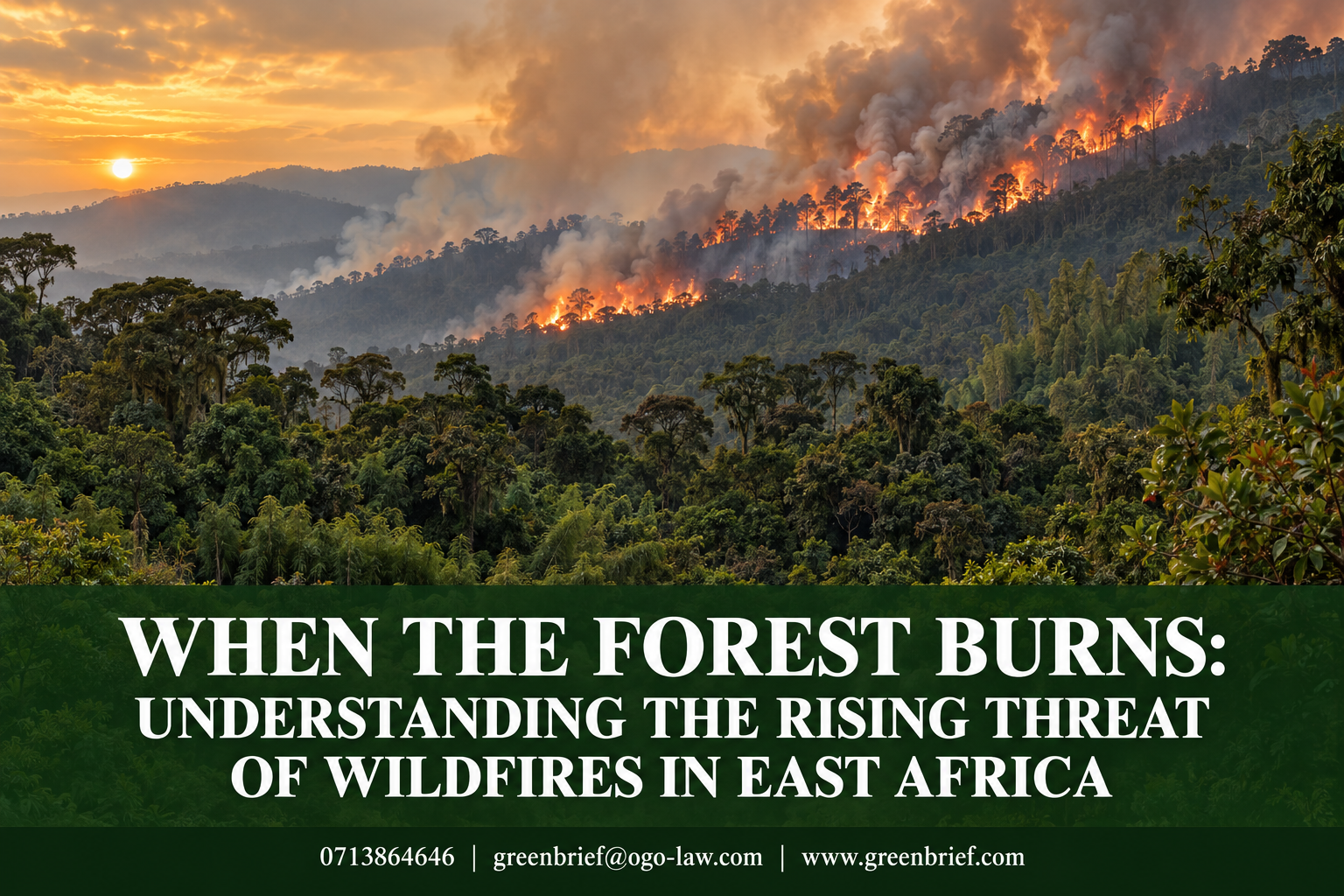

Across East Africa, fire is becoming an increasingly visible threat to forests, grasslands, wildlife habitats and the communities that depend on them. In recent weeks, fires in Kenya and Tanzania have once again highlighted the vulnerability of the region’s landscapes. In Kenya, a fire in the Aberdare Forest reportedly destroyed more than 200 acres, with strong winds making containment difficult. Authorities suspected that the blaze may have been accidentally started by honey harvesters operating in the forest. In Tanzania, a fire that broke out in the Kikerelwa area of Kilimanjaro National Park on 3 September 2026 had been more than 90 per cent contained by 5 September, with firefighters supported by helicopters, tourism operators and neighbouring communities.
These incidents are not isolated. Uganda has also experienced destructive wildfires, including fires that have affected forests, farms and settlements. In Nakasongola, more than 1,000 hectares of plantations and gardens were reported burned within a single week in February 2025, while fires in northern Uganda have repeatedly affected communities during dry and windy periods.
The pattern raises a critical question: why are these fires becoming such a persistent threat, and what can East Africa do differently to prevent them?
THE FIRE IS OFTEN HUMAN, BUT THE CONDITIONS ARE ENVIRONMENTAL
Wildfires are rarely caused by a single factor. They occur when an ignition source meets dry vegetation, suitable weather conditions, and a landscape capable of carrying fire.
Human activity remains one of the most significant causes. The Food and Agriculture Organization (FAO) notes that most wildfires globally are associated with human activity, including agricultural burning, land clearing, livestock management, hunting, extraction of forest products, negligence, and deliberate burning.
East Africa reflects many of these pressures. In Kenya, documented causes include agricultural land preparation, charcoal burning, honey harvesting, campfires, hunting and poaching, cigarette smoking and arson. Lightning is also an important natural ignition source.
The problem becomes more severe when these ignition sources occur during prolonged dry periods. Dry grass, shrubs, bamboo, fallen leaves and other vegetation become highly flammable. Strong winds can then transform a small fire into a rapidly spreading wildfire. This was evident in the Aberdare fire, where strong winds complicated firefighting efforts.
Climate change adds another layer to the problem. Rising temperatures, changing rainfall patterns and prolonged periods of drought can dry vegetation and extend periods of high fire risk. FAO warns that increasing temperatures and drought associated with climate change are expected to contribute to increases in the incidence and intensity of vegetation fires.
But climate change should not become an excuse for ignoring human responsibility. A hotter and drier environment does not start every fire. People still provide many of the sparks.
This distinction matters because it changes how wildfire prevention is approached. If fires are treated only as natural disasters, governments may focus primarily on fighting them after they have started. If they are understood as a combination of human activity, land-use practices, weather and ecological conditions, prevention can begin long before the first flame appears.
FROM FIRE RESPONSE TO FIRE PREVENTION
The region needs to move from a predominantly reactive approach to a comprehensive system of prevention, preparedness, rapid response and recovery.
First, fire-risk mapping and early-warning systems need to become a central part of forest management. Authorities should be able to identify areas with high fuel loads, prolonged dryness, strong winds, and previous fire incidents, allowing resources to be positioned before a fire starts. Satellite monitoring, ranger patrols, lookout points and community reporting systems can help detect fires while they are still small.
Second, the use of fire in agriculture and pastoralism needs stronger management. This does not necessarily mean banning every form of controlled burning. In some landscapes, fire has ecological and livelihood functions. The challenge is ensuring that where fire is used, it is used under appropriate weather conditions, with adequate firebreaks, supervision, and clear responsibility. FAO’s integrated fire management approach emphasises prevention, preparedness, response and recovery rather than relying solely on suppression.
Third, communities living around forests and protected areas must be treated as partners rather than simply as potential sources of fire. Local communities often know where fires start, which areas are most vulnerable and how quickly conditions can change. They can also be the first people capable of detecting and reporting a fire.
Community-based fire management therefore has an important role to play. FAO highlights community participation as a key component of effective wildfire prevention and response, particularly because local people can act quickly when fires emerge.
There is also a need to strengthen the institutions responsible for managing forests and protected areas. Fire management requires trained personnel, reliable equipment, communications systems, protective gear, transport, water access and adequate financing. It also requires coordination between forestry agencies, wildlife authorities, county and local governments, disaster-management institutions, communities and emergency services.
Most importantly, fire management cannot end when the flames disappear.
Burned landscapes require assessment and rehabilitation. Forest recovery should prioritise native ecosystems and natural regeneration where appropriate rather than treating every burned area simply as an opportunity for tree planting. Authorities should also investigate the causes of fires, document damage and identify what could have prevented the incident.
The answer to East Africa’s wildfire challenge is therefore not simply more firefighting equipment. It is better land management, stronger enforcement, community participation, early warning, responsible use of fire and climate-resilient conservation.
Forests are not only collections of trees. They regulate water, store carbon, protect soils, support biodiversity and sustain communities. When they burn, the consequences extend far beyond the blackened landscape.
The recent fires across East Africa should therefore be treated not as isolated emergencies, but as warnings. The question is no longer whether the region can put out the next fire. It is whether we can prevent the next fire from becoming a disaster.