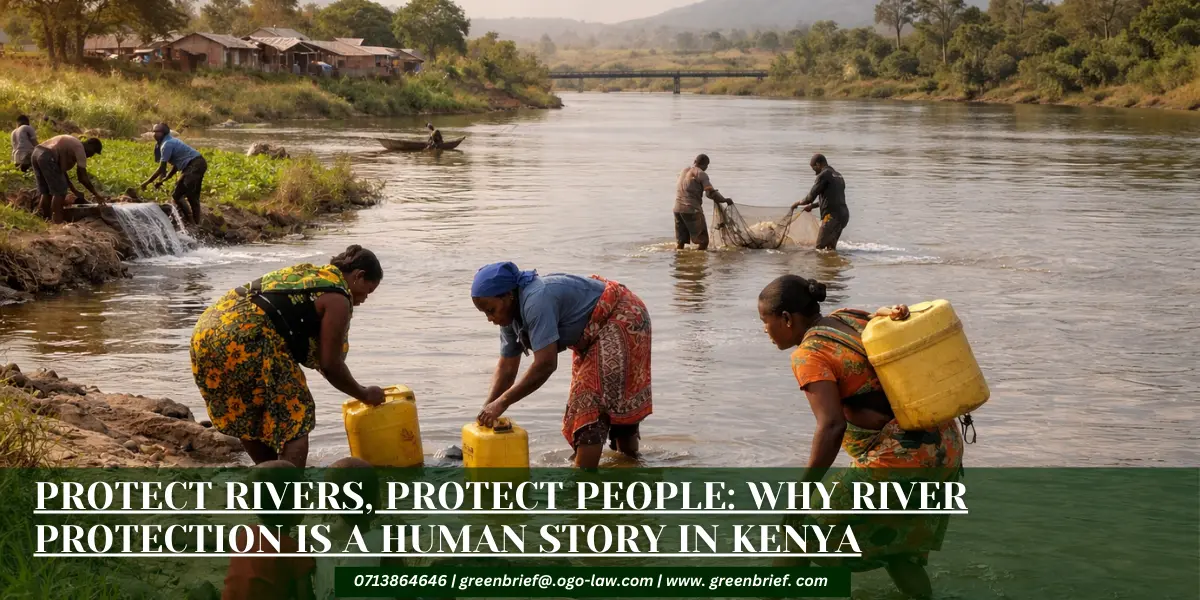

At sunrise along the banks of the Tana River, farmers walk quietly toward the water with jerrycans. A few hundred kilometres away, Nairobi River flows through crowded neighborhoods where children play only metres from polluted water. Further south west, the Mara River sustains one of the most extraordinary wildlife ecosystems in the world while also providing water for pastoral communities. These rivers tell different stories but they share one truth.
The fate of rivers and the fate of people are inseparable.
This is precisely the message behind the 2026 International Day of Action for Rivers, whose theme ‘Protect Rivers, Protect People’ reminds us that river protection is not only an environmental concern, but also a matter of public health, economic survival, ecological integrity, and justice.
For Kenya, this is unfolding in real time.
Rivers as Lifelines in the Kenyan Landscape
Rivers form the ecological backbone of Kenya.
Tana River, the country’s longest river, powers the Seven Forks Scheme dams that contribute a significant portion of Kenya’s renewable energy. Athi River greatly supports industries across large parts of the country. Mara River, on the other hand, sustains pastoral livelihoods while supporting the globally renowned wildebeest migration.
Yet, these same rivers are under increasing pressure. Rapid urbanisation, industrial emissions, deforestation in water catchment areas and encroachment on riparian land have placed immense strain on river systems.
The consequences of these pressures are rarely confined to ecosystems alone. Communities often experience the most immediate effects: unsafe drinking water, reduced agricultural productivity, flooding, and the gradual erosion of livelihoods.
When a river deteriorates, it is not only the environment that suffers, it is the people.
Kenya’s Legal Foundation for River Protection
The Constitution of Kenya 2010 establishes environmental protection as a fundamental right. Article 42 guarantees every person the right to a clean and healthy environment, including the right to have the environment protected for the benefit of present and future generations. This right reflects an important understanding, that environmental degradation is not simply an ecological issue, but also a threat to human dignity, health, and survival.
Importantly, Article 70 allows any person to approach the courts to prevent environmental harm without needing to demonstrate personal loss or injury. In practical terms, the Constitution recognises that environmental harm affects society collectively.
Further, the Environmental Management and Coordination Act 1999, provides the overarching framework for environmental governance. Among its key requirements is the obligation to conduct Environmental Impact Assessments (EIAs) for projects that may significantly affect the environment, including developments near rivers, wetlands, and water catchment areas.
Complementing this framework is the Water Act 2016, which regulates the management, conservation, and allocation of water resources. Institutions such as the Water Resources Authority are mandated to protect rivers, regulate water use, and safeguard catchment areas.
Together, these laws recognise that rivers must be managed not merely as economic assets, but as complex ecological systems essential to human survival.
The Enforcement Gap
Despite Kenya’s strong constitutional and statutory framework, the protection of rivers often falters at the stage of implementation and enforcement.
From a legal perspective, this is where the greatest challenge lies.
Kenya does not lack environmental laws. On paper, the legal framework governing rivers is robust. The Constitution guarantees environmental rights, statutes regulate water use, and regulatory institutions exist to oversee compliance. Yet in practice, rivers continue to suffer from pollution, illegal abstraction, and encroachment. Several factors contribute to this enforcement gap:
First, institutional capacity constraints often limit the ability of regulatory bodies to monitor and enforce compliance across vast river basins. Environmental agencies may lack adequate funding, personnel, or technical resources to effectively regulate activities along rivers.
Second, conflicting development priorities sometimes undermine environmental protection. Infrastructure projects, industrial expansion, and urban development may proceed despite environmental risks, particularly where economic considerations are prioritised over ecological sustainability.
Third, weak compliance culture remains a persistent challenge. Environmental Impact Assessments may be conducted, but mitigation measures are not always implemented or monitored effectively.
From the legal perspective, environmental litigation has increasingly become an important mechanism for bridging this enforcement gap. Strategic litigation has allowed courts to hold both public authorities and private actors accountable where environmental obligations are ignored. However, litigation should not be the primary mechanism for protecting rivers. Ideally, strong regulatory enforcement should prevent environmental harm before courts need to intervene.
The theme ‘Protect Rivers, Protect People’ highlights an important dimension of environmental law, justice.
Fishing communities, small-scale farmers, and rural populations are communities that depend most heavily on rivers, and are often the most vulnerable to environmental degradation. When rivers are polluted or diverted, these communities face immediate and tangible consequences.
Environmental law plays a critical role in ensuring that development decisions do not impose disproportionate burdens on these vulnerable populations. Protection of these rivers is a matter of social equity and human rights.
As the world marks the International Day of Action for Rivers, Kenya must continue strengthening its commitment to safeguarding these vital ecosystems, because in the end, protecting rivers is not only about protecting nature. It is about protecting life itself.