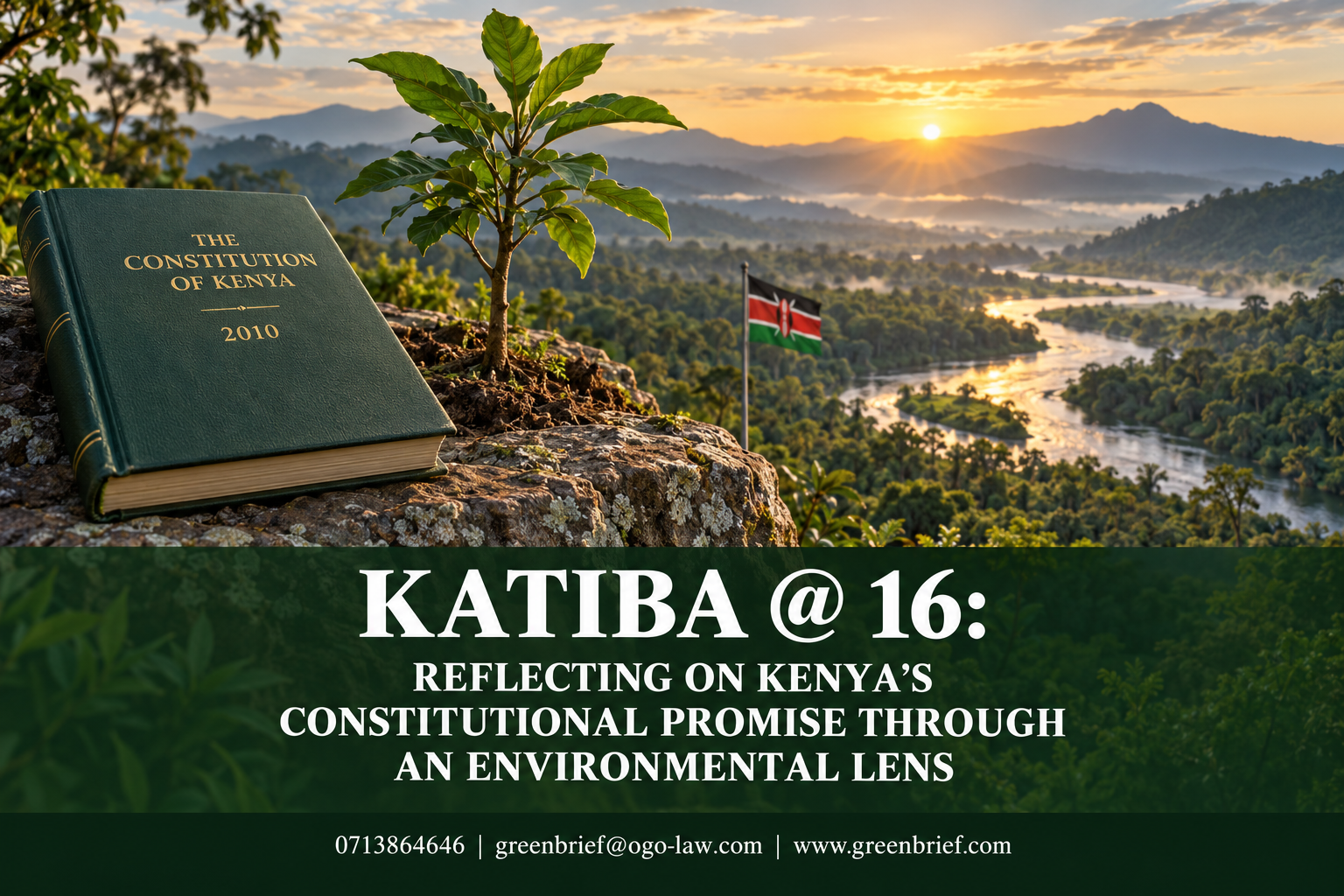

Sixteen(16) years ago, Kenyans ushered in a new constitutional order founded on the promise of a more just, equitable and accountable society. The promulgation of the Constitution of Kenya, 2010 was not merely a legal event, it was a collective expression of the kind of country Kenyans wanted to build and leave for future generations.
It is therefore important to reflect on that vision through an environmental lens. What did the framers of the Constitution envision when they placed the environment within the constitutional framework? and, sixteen years later, how close are we to realising that vision?
The framers of the Constitution understood that human well-being is inseparable from the environment. This recognition is reflected most clearly under Article 42 which guarantees every person the right to a clean and healthy environment. This was a significant departure from treating environmental protection as merely a matter of government policy. The environment became a constitutional right.
Equally, the Constitution imposes obligations on both the State and citizens. Article 69 requires the State to ensure sustainable exploitation, utilisation, management and conservation of the environment and natural resources. It calls for the elimination of processes and activities likely to endanger the environment, encourages public participation in environmental management and requires the establishment of systems for environmental impact assessment, environmental audit and monitoring.
Underlying these provisions is a broader constitutional vision, that is, DEVELOPMENT MUST BE SUSTAINABLE, PARTICIPATORY AND EQUITABLE. The framers were therefore not simply concerned with protecting trees, rivers or wildlife. They envisioned a country where development and environmental stewardship would reinforce one another, where citizens would have a voice in decisions affecting their surroundings and where natural resources would be managed in a manner that serves both present and future generations.
This intergenerational dimension is particularly important. Kenya’s natural resources are not ours to consume without consequence. They are part of an inheritance entrusted to us with a responsibility to ensure that those who come after us can also enjoy a clean and healthy environment.
Sixteen Years On, The Reality We Face
The greatest success, so far, is that environmental protection is now a constitutional right not merely a policy aspiration. This is seen through Article 42, 69 and 70 of the Constitution of Kenya. Additionally, the Constitution has also strengthened the role of the judiciary as an avenue for environmental justice. Courts have consistently demonstrated that Article 42, 69 & 70 are not symbolic provisions but enforceable constitutional obligations.
Be that as it may, Kenya is still grappling with the effects of climate change which has made weather patterns more unpredictable, with communities experiencing cycles of drought and devastating floods. These events have consequences far beyond the environment. They affect food security, livelihoods, water availability, health, housing and economic stability. At the same time, we continue to grapple with deforestation, degradation of water catchment areas, loss of wetlands, biodiversity loss, pollution and poor waste management.
Further, We are witnessing continued pressure on forests, wetlands, rivers and other critical ecosystems, alongside biodiversity loss, pollution and poor waste management. Competition over land, water and other resources can deepen inequalities and expose already vulnerable communities to greater environmental risks. Equally, rapid, often poorly planned urbanization, loss of green spaces and infrastructure development are placing additional pressure on ecosystems and natural resources and affecting the quality of life of millions of people, especially in urban areas.
These challenges are becoming more urgent because environmental degradation is no longer experienced as an isolated ecological concern. When a wetland is destroyed, communities may lose natural flood protection. When a forest is degraded, water systems and livelihoods can be affected. When development proceeds without adequate environmental safeguards, the consequences can extend across generations.
It is also important to poin out that environmental issues are no longer confined to policy discussions but are increasingly finding their way into our courts, demonstrating the extent to which environmental governance has become a constitutional question.
Constitutional promise vis-a-vis implementation
Progressive constitutional provisions are an important first step but rights must be translated into action through effective institutions, enforcement, responsible development, meaningful public participation and accountability. Environmental governance cannot be reduced to obtaining licences or conducting consultations as procedural requirements. It must be about making decisions that genuinely protect ecosystems while recognising the rights and interests of affected communities.
Therefore, Katiba@16 presents an opportunity to not only celebrate what the Constitution achieved but also interrogate what remains unfinished. The environmental provisions of the Constitution were ahead of their time. The challenge today is to ensure that they remain relevant to the realities we face. As climate change intensifies, environmental governance must become central to development planning. As our population grows and cities expand, sustainability must shape how we use land. As pressure on natural resources increases, equity and community participation must remain at the heart of decision-making.