
Introduction
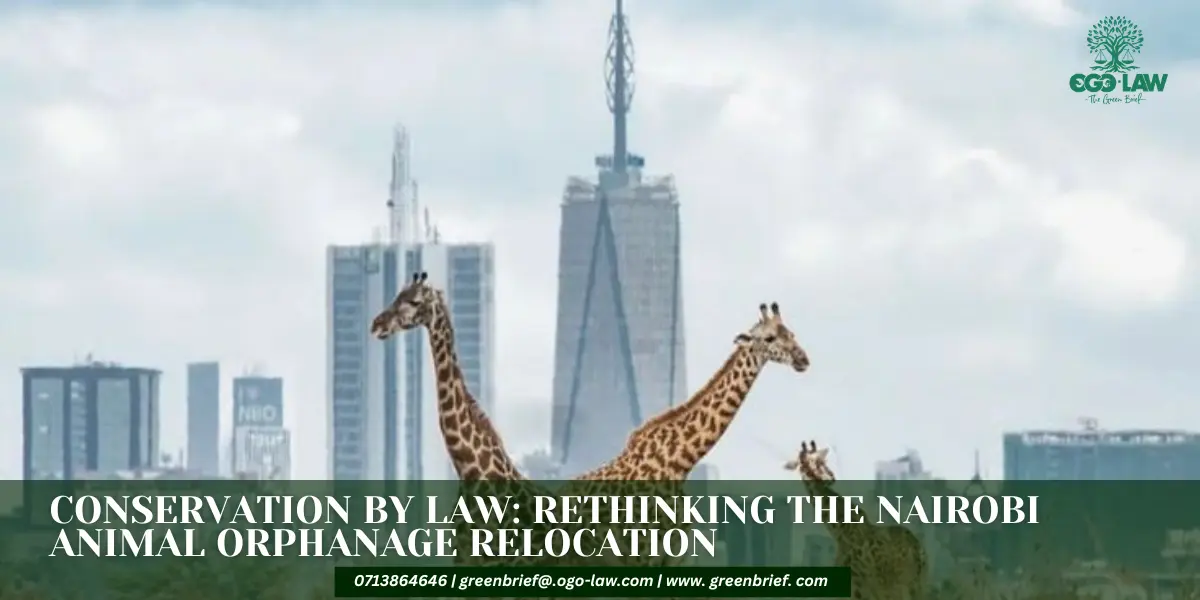
The ongoing discourse surrounding the proposed relocation of the Nairobi Animal Orphanage within Nairobi National Park has largely been framed in emotive and advocacy-driven terms, which is understandable given the sensitivities involved. However, at its core, the issue is a legal one. The main question is whether a development of this nature can lawfully take place within a protected area. The answer is yes, but only under specific conditions.
Kenyan Laws
Kenyan law, particularly the Environment Management and Coordination Act, 1999 and the Wildlife Conservation and Management Act, 2013, does not impose an absolute prohibition on development within conservation areas. The law recognises that conservation landscapes do not exist in isolation from broader socio-economic realities. In limited circumstances, carefully controlled development may take place within conservation landscapes. However, such development is only permitted within a tightly regulated framework that demands clear justification, strict adherence to process, and a high degree of environmental caution.
This process usually includes the preparation of an environmental impact assessment, the securing of regulatory approval, and the conduct of meaningful public participation. These procedural steps are safeguards, intended to ensure that decisions made are informed, transparent, and responsive to environmental concerns. Public participation, in particular, requires more than a mere formal notice. It calls for genuine engagement with affected stakeholders and a proper recording of these engagements.
Where an Environmental Impact Assessment licence has been issued by the National Environment Management Authority(NEMA), the project benefits from a presumption that the proper process has been followed. That presumption, however, is not absolute, as it may be challenged where there is reason to believe that the process followed was inadequate, key issues were overlooked, or that environmental risks and mitigation measures were not properly assessed or addressed.
The Substantive Test for Conservation Decisions
The main question that arises is this: does the project advance conservation, or does it compromise it?
On one hand, a modernised orphanage may enhance animal welfare, improve rehabilitation outcomes, and align with evolving conservation standards. On the other, its relocation and redevelopment raises concerns about habitat disturbance, ecological integrity, and the incremental normalisation of development within protected spaces.
Under Kenyan environmental law jurisprudence, the exercise of State power in relation to protected areas is guided by settled principles, most notably the precautionary principle and the public trust doctrine, which together define the standard against which such decisions are to be assessed.
The public trust doctrine places natural resources within a legal framework of stewardship. The State does not hold natural resources for its own benefit, but in trust for present and future generations. Its role is therefore fiduciary in nature, requiring making of decisions that protect ecological integrity over time. This means that a decision that privileges short-term convenience at the expense of long-term environmental sustainability sits uneasily with that obligation.
The precautionary principle complements this duty. Where there is uncertainty as to environmental impact, the law requires serious caution. The absence of complete scientific certainty calls for a more careful approach, particularly where the potential harm is serious or irreversible. This reflects a consistent thread in environmental law jurisprudence, that preventive action is to be preferred to remedial measures after damage has occurred.
Taken together, these principles impose a disciplined standard of decision-making. It is not enough that a project is administratively convenient or even beneficial in the short term. The State must be able to demonstrate that its decision is consistent with its trustee obligations and that environmental risks have been properly identified, assessed, and addressed. Where that standard is not met, the decision is properly open to legal challenge.
Equally significant is the constitutional dimension. Article 42 of the Constitution of Kenya, 2010 guarantees every person the right to a clean and healthy environment. This right is is enforceable, and it informs how courts assess the legality of environmentally sensitive decisions.
From a legal standpoint, therefore, the viability of the proposed relocation turns on three questions:
- Was the process lawful and procedurally sound?
- Are the environment safeguards sufficient and credible? and
- Does the project, on a balance of probability, promote rather than undermine conservation objectives?
If this threshold is met, the project is defensible in law. If it is not, it becomes susceptible to challenge regardless of its stated intentions.
Conclusion
In conclusion, the legality of any proposed development within a protected area must be assessed strictly within the framework of Kenyan environmental law and established principles of environmental jurisprudence. The issuance of an Environmental Impact Assessment licence is not, of itself, determinative of legality where statutory and constitutional safeguards remain in issue. Rather, such decisions are lawful only to the extent that they comply with the requirements of the Environmental Management and Coordination Act, 1999 and the Wildlife Conservation and Management Act, 2013, and are consistent with principles of environmental stewardship. In particular, such compliance must be substantive and not merely procedural in appearance.
Where it is not evident that due process was meaningful, that public participation was effective, or that environmental risks were fully evaluated and mitigated, the resulting decision cannot be regarded as beyond legal scrutiny. In such circumstances, the law requires closer interrogation of the validity of that decision.
Accordingly, authority exercised over conservation land is lawful only to the extent that it reflects fidelity to the State’s obligations under the public trust doctrine and the precautionary principle. Anything short of that standard renders the decision legally vulnerable.