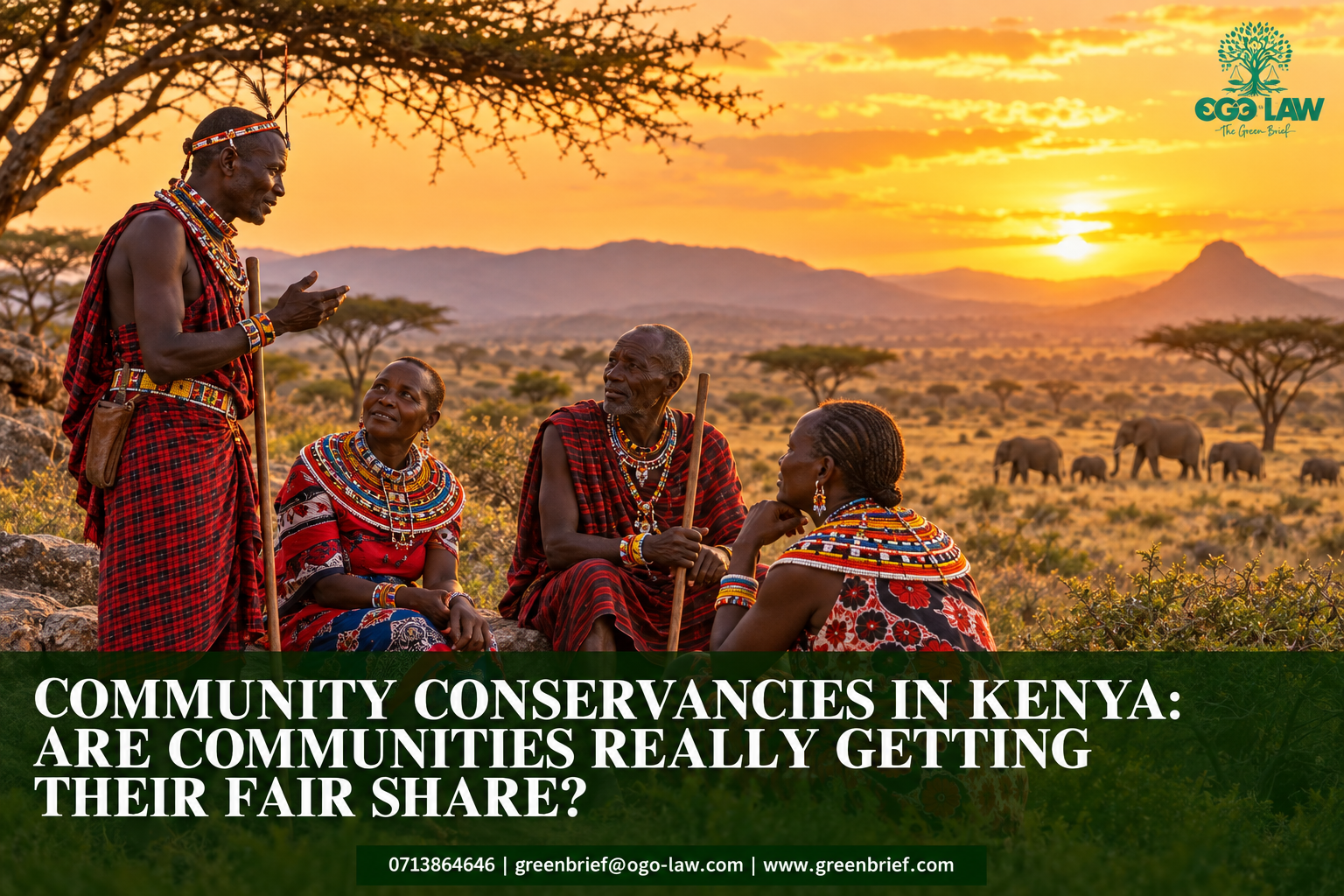

Community conservancies now cover close to eleven per cent of Kenya’s land area,hosting more wildlife outside national parks and reserves than within them. The model rests on a simple bargain: communities set aside their land and tolerate the costs of living with wildlife , crop destruction, livestock predation, and the everyday risk that comes with sharing a landscape with elephants and predators , in exchange for a fair share of the benefits that conservation generates. It is a bargain written into our Constitution and our statutes. The question this piece asks is whether, on the ground, that bargain is actually being kept.
The Constitution obligates the State to ensure the sustainable exploitation, utilisation, management and conservation of the environment, and to encourage public participation in that management. It also recognises and protects community land, the tenure category on which most conservancies sit, as land owned collectively by an identifiable community rather than by any individual member. Kenya’s wildlife legislation operationalises this constitutional promise, declaring in terms that could not be plainer that benefits accruing from wildlife conservation and management shall be enjoyed and equitably shared by the people of Kenya. The law recognises community wildlife associations and creates the statutory basis for benefit-sharing arrangements between conservancies, tourism investors, and the State. Community land legislation complements this by providing the legal architecture through which community land and by extension the conservancies built on it are to be registered, governed and administered.
On paper, Kenya’s framework is progressive and constitutionally grounded. The difficulty is that a right to “equitable” benefit sharing means very little without a formula, a monitoring mechanism, and an enforcement body standing behind it and this is precisely where the law falls silent. It does not prescribe how benefits are to be calculated, distributed, audited, or contested. It leaves the how entirely to individual conservancy governance structures, some of which are transparent and well run, and others of which are not.
What “Equitable” Looks Like in Practice and What It Doesn’t
Where the system works, conservation revenue is channelled into schools, healthcare, water infrastructure and security, administered through community-approved structures, or paid out as direct lease payments to individual landowners. This is the model at its best: tangible, visible value flowing back to the people who bore the cost of setting land aside.
None of this is a failure of the law’s aspiration. It is a failure of the plumbing beneath its accurate registers, verified succession, direct payment, and guardianship safeguards without which “equitable benefit sharing” remains a constitutional slogan rather than a lived reality for the pastoralist family waiting for a payment that a relative received on their behalf three lease agreements ago.
The Courts Have Already Said Consent Cannot Be Assumed Kenyan courts have on more than one occasion had to test whether conservancy arrangements meet the constitutional bar. In one landmark case, the court held that establishing conservancies on community land without adequate consultation violated constitutional public participation requirements and undermined community land rights, a ruling that brought the principle of Free, Prior and Informed Consent sharply into focus even though that principle is not yet expressly written into Kenya’s wildlife legislation. In another, the court went further, holding that projects implemented on community land must guarantee equitable sharing of benefits as a matter of social justice, not discretion. A third decision reinforced that public participation in projects affecting communities must be effective, inclusive, and continuous, not a box-ticking exercise conducted after key decisions have already been made. Taken together, these decisions confirm that benefit sharing and consent are constitutional obligations, not optional best practice but they also confirm, by the fact that litigation was necessary at all, that communities cannot yet assume the system will get this right without a fight.
The Governance Gap Within Conservancies Themselves
Governance within conservancies typically runs through community-elected boards, management committees, and general assemblies responsible for financial oversight and stakeholder engagement. Where these structures are transparent and inclusive, conservancies deliver real socio-economic value. Where they are not, the usual complaints follow: limited representation of women and young people in leadership, weak financial reporting, and disputes over how revenue is calculated and shared. The Constitution promotes equality and inclusion in exactly this kind of decision-making space, yet leadership positions in many conservancies continue to be dominated by a narrow set of established local actors, a governance deficit the law does not currently require conservancies to correct.
Cultural Practices Deserve a Seat at the Table Too.
Equity is not only about the size of the cheque. Pastoralist and indigenous communities hosting conservancies hold land, grazing rights, and succession according to customary practices that predate and sometimes sit uneasily beside the statutory registration model now governing community land. A framework that treats “benefit sharing” purely as a revenue-distribution exercise, without also protecting customary governance, grazing corridors, and cultural sites within conservancy boundaries, risks delivering a check while quietly eroding the cultural fabric that made the community worth partnering with in the first place. Genuine equity has to hold both: fair economic return, and respect for the customary practices communities never agreed to trade away.
Where does this leave us?
Kenya has built a constitutional and statutory foundation for equitable benefit sharing that is genuinely progressive on paper. What is missing is the machinery to make that promise real: enforceable distribution formulas, harmonisation between wildlife and community land legislation, accelerated community land registration, mandatory free, prior and informed consent before any conservancy is established, and basic governance safeguards like accurate membership registers, verified succession, and direct payment to individual members. Communities are not asking conservation to give way to their interests. They are asking that the law it already promised them actually be delivered accurately, transparently, and without anyone else standing between them and what is theirs.