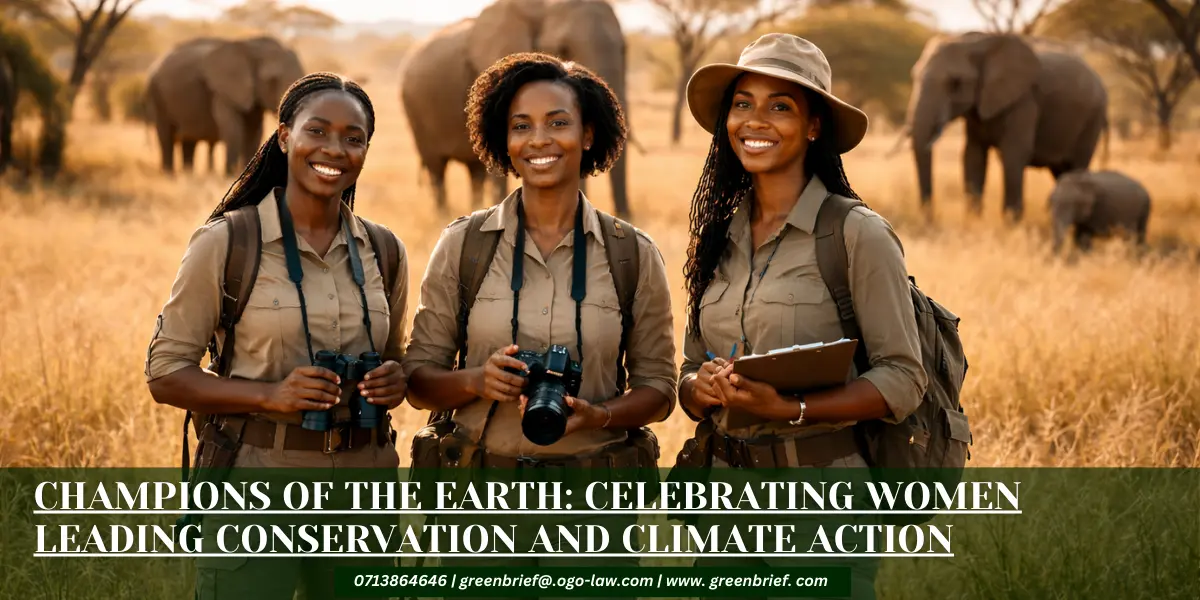

Across Kenya and Africa, women have played a transformative role in environmental protection, wildlife conservation and climate action. Their leadership has reshaped how communities interact with nature, emphasizing ecological sustainability, social justice and long-term resilience. A pioneering figure is Wangari Maathai, founder of the Green Belt Movement, which mobilized rural women to plant millions of trees, restoring degraded landscapes while empowering women through livelihoods and environmental education. In wildlife conservation, leaders like Paula Kahumbu have advocated for stronger laws, raised public awareness about threats to elephants and other endangered species, and promoted community-based conservation through WildlifeDirect.
Women also lead in community conservancies and rangelands, driving restoration projects, sustainable livelihoods, and climate adaptation initiatives. At the policy level, African women influence international climate and biodiversity frameworks, ensuring solutions are equitable and inclusive. These efforts show that women are not just participants but leaders shaping a sustainable future for Kenya’s landscapes, wildlife, and communities.
- Wangari Maathai – A Pioneer of Environmental Justice
Wangari Maathai remains one of Kenya’s most influential environmental leaders and a global symbol of environmental justice. As the founder of the Green Belt Movement, she pioneered a powerful approach to conservation that connected environmental protection with human rights, democracy, and women’s empowerment.
What began as a grassroots tree-planting initiative has evolved into a nationwide environmental movement. Through this process, communities have not only restored degraded landscapes but also gained environmental knowledge, leadership skills and economic opportunities. Today, her legacy continues to inspire environmental movements across Africa and the world, reminding us that community-driven environmental protection can transform both landscapes and societies.
- Elizabeth Gitari Mitaru – Environmental Law, Conservation Law and Climate Change Advocate
Elizabeth Gitari Mitaru is an Advocate of the High Court of Kenya. She plays an important role in strengthening environmental governance in Kenya through her work in environmental law, conservation law and policy development. Her contributions highlight the critical role that legal professionals play in protecting ecosystems, ensuring accountability, and guiding responsible management of natural resources.
By contributing to the development and application of environmental law, Elizabeth Gitari Mitaru represents an important part of Kenya’s growing network of legal professionals working to advance sustainability and environmental accountability. Her efforts demonstrate that effective environmental protection requires not only scientific knowledge and community action, but also strong legal systems capable of safeguarding ecosystems for present and future generations.
- Wanjira Mathai – Kenyan Environmentalist and Climate Resilience Advocate
Wanjira Mathai has emerged as one of Africa’s leading voices in climate justice and Nature Based Solutions. Building on a legacy of environmental leadership, she continues to champion sustainable development and ecological protection across the continent and beyond.
One of her most influential contributions is her role in the African Forest Landscape Restoration Initiative (AFR100). This continental initiative aims to restore 100 million hectares of degraded and deforested land across Africa by 2030, making it one of the world’s largest restoration commitments. Wanjira Mathai continues to bridge grassroots environmental action with global policy conversations. Her work highlights the growing role of African leadership in shaping climate solutions and advancing a future where restored landscapes support both ecological health and sustainable livelihoods across the continent.
- Paula Kahumbu – A National Voice for Wildlife Conservation
Paula Kahumbu is widely recognized as one of Kenya’s most influential voices in wildlife conservation. As the Chief Executive Officer of WildlifeDirect, she has played a critical role in advocating for stronger wildlife protection, raising public awareness about biodiversity loss and mobilizing national support for conservation initiatives.
Dr. Kahumbu’s work has focused particularly on addressing the growing threats of elephant poaching and wildlife trafficking, which have historically posed serious risks to Kenya’s wildlife populations. Through consistent advocacy and public engagement, she has helped highlight the urgent need for stronger enforcement of conservation laws and greater accountability in protecting the country’s natural heritage.
One of her most significant contributions came during the development and advocacy surrounding the Wildlife Conservation and Management Act. This landmark legislation introduced tougher penalties for wildlife crimes, including higher fines and longer prison sentences for poaching and trafficking offenses. The law represented a major step forward in strengthening Kenya’s wildlife protection framework and signaling a national commitment to safeguarding biodiversity.
Through initiatives led by WildlifeDirect, she has also supported education programs that engage young people in conservation, helping cultivate a new generation that values and protects nature. These efforts have helped build stronger public awareness around the importance of wildlife to Kenya’s identity, economy, and ecological health.
Dr. Kahumbu’s leadership demonstrates the power of advocacy, education, and policy reform in advancing conservation goals. By connecting science, storytelling, and public engagement, she continues to inspire Kenyans to take pride in protecting the wildlife and ecosystems that define the nation’s natural heritage.
- Dr. Claire Okell – Founder of the Pangolin Project Kenya
Claire Okell is a dedicated conservationist working with the Pangolin Project Kenya, an initiative committed to protecting one of the world’s most trafficked and least-known mammals, the pangolin. Often called “the scaly anteater” pangolins play an important ecological role by controlling insect populations, yet they face severe threats from illegal wildlife trade and habitat loss. Claire Okell’s contributions demonstrate the importance of attention to species that often receive less recognition than flagship animals like elephants or lions. Conserving pangolins is not only about saving a single species but also about maintaining ecological balance, supporting insect population control and ensuring the health of habitats that sustain diverse forms of life.
- Team Lioness – Anti-poaching rangers
Team Lioness is a groundbreaking, all-female ranger unit based in Kenya’s Amboseli ecosystem. Established in 2019, the team began with eight Maasai women who became the first from their community to serve as anti-poaching rangers. By stepping into a field traditionally dominated by men, they challenge cultural norms while making a significant impact on wildlife conservation in one of Kenya’s most iconic landscapes.
Beyond environmental protection, Team Lioness represents a major step toward gender empowerment. Maasai women have traditionally had limited access to formal employment and leadership roles, particularly in conservation. By taking on these positions, the rangers are redefining expectations and inspiring young women in their communities to pursue careers in environmental stewardship.
The stories of these women remind us that protecting the environment is not the work of a single institution or profession, it is a collective effort driven by passion, leadership, and commitment to future generations. From planting trees and restoring degraded landscapes to shaping environmental policy, protecting wildlife, and strengthening community-led conservation, these women have shown that meaningful change is possible when courage and vision meet action. Their work has not only helped safeguard Kenya’s forests, wildlife, and ecosystems, but has also inspired new generations of environmental leaders across Africa.
As we celebrate their contributions, we are also reminded that conservation is a shared responsibility. Supporting women in environmental leadership, amplifying their voices, and investing in community-driven conservation will remain essential in protecting the natural heritage that sustains us all.