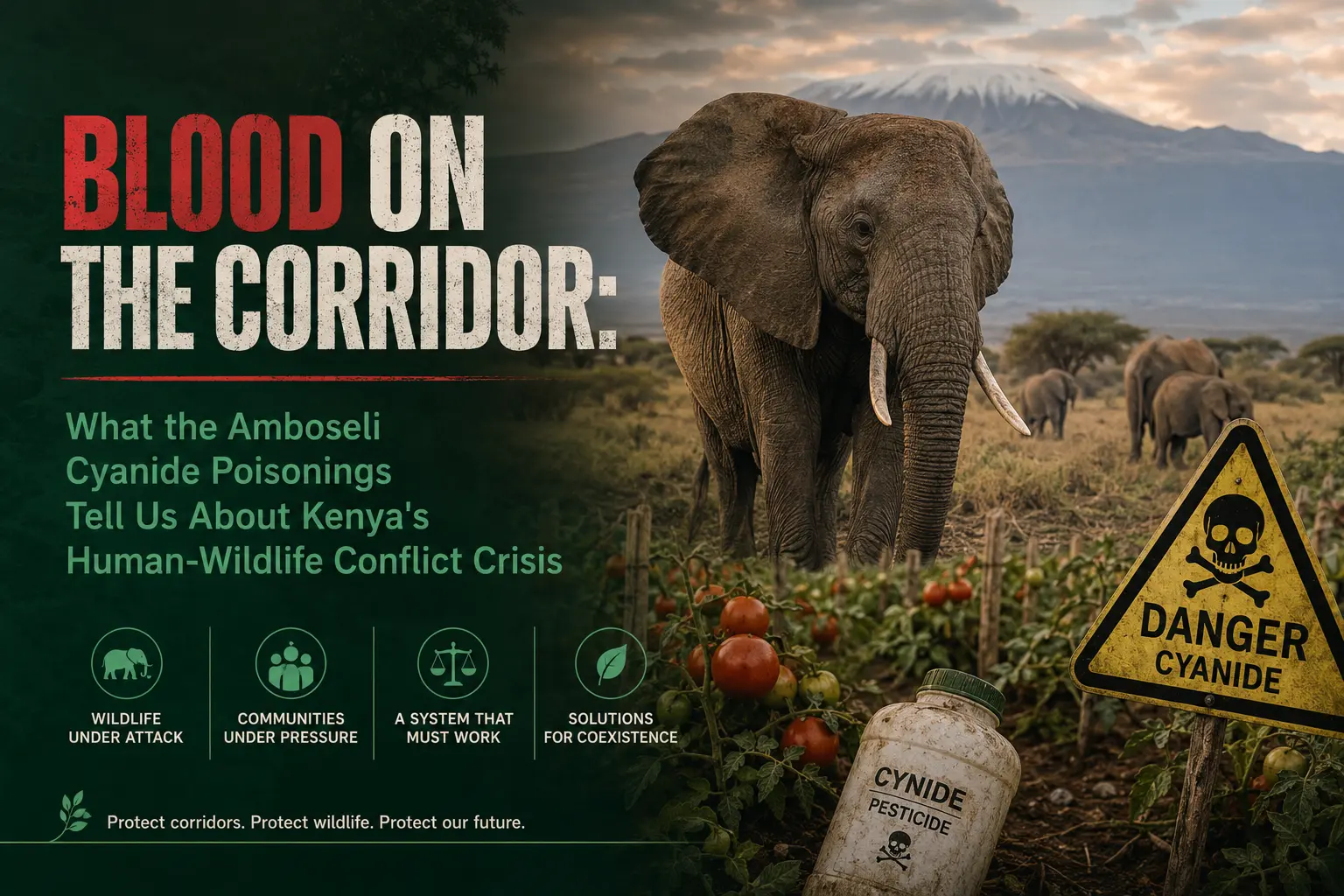

Between 24 June and 24 July 2026, fifteen elephants died across the Amboseli ecosystem in Kajiado County, in a slow, monthlong wave that alarmed rangers and conservationists long before anyone could explain it. On 29 July 2026, the Kenya Wildlife Service confirmed the cause: cyanide poisoning, with preliminary laboratory analysis pointing to elephants ingesting agricultural chemicals sprayed on tomato farms bordering Amboseli National Park, Kimana Wildlife Sanctuary and the Kuku Ranch area. It came only six months after six lions and thirty two vultures were poisoned at Kitenden Conservancy in January 2026, a community-owned corridor that links Amboseli to Mount Kilimanjaro National Park across the Tanzanian border. A further KWS update issued on Friday, 7 August 2026 revised the death toll to sixteen and reopened the question of source, adding a natural-plant hypothesis alongside the pesticide theory.
This piece works through the questions that naturally follow such an incident: whether the poisoning was intentional retaliation by farmers tired of losing crops to elephants, why communities living inside migratory corridors resort to such methods at all, whether Kenya’s compensation architecture under the Wildlife Conservation and Management Act, 2013 is actually functioning as designed, where a substance as tightly controlled as cyanide comes from, and what all of this means for the people who live alongside these corridors, not just the animals that pass through them. As of this writing, KWS has not concluded that the poisoning was deliberate, and nobody has been publicly charged. That gap between what has happened and why matters a great deal, and we have tried to flag where the public record goes quiet rather than filling the silence with a guess.
What Happened in Amboseli
KWS Director-General Prof. Erustus Kanga confirmed that post-mortem examinations by KWS veterinarians detected cyanide traces in the digestive systems of the fifteen elephants. The pattern of death was telling in itself: a herd at Kimana Wildlife Sanctuary lost six animals in a short window, ten animals showed partial paralysis before dying within two days of exposure, and five carcasses were only found after scavengers had already reached them. Most of the dead were females and calves, with just one adult male among them. KWS spokesperson Duncan Wanyama described cyanide as a substance that attacks the lungs and liver, and investigators traced the likely source to tomatoes grown on farms neighbouring the park that had been treated with what he called a “very strong pesticide.”
This was not an isolated event, and that is part of what makes it hard to read as pure accident. In January 2026, six lions and thirty two vultures died at Kitenden Conservancy on the Kenya Tanzania border, at a moment when drought had sharpened the competition for pasture and water between livestock and wildlife across the same landscape.
The KWS issued an update revising the toll to sixteen elephants, with deaths recorded between 24 June and 31 July across the wider Amboseli-Kimana-Kitenden ecosystem. KWS confirmed it had deployed veterinary and scientific teams from Nairobi, Tsavo and Amboseli, and had been working with the Government Chemist and the University of Nairobi to conduct toxicological, microbiological and other laboratory analyses on samples from the carcasses, alongside water sampling and environmental contamination assessments. The statement was explicit that this remains preliminary: “Preliminary laboratory analysis by the University of Nairobi indicates cyanide poisoning as the probable cause in the cases examined. KWS is awaiting completion of confirmatory testing to align laboratory findings with individual case records and to trace the exposure pathways and origin.” KWS Director-General Prof. Kanga also stated there is no indication of an infectious or transmissible disease, and that Amboseli National Park remains open and fully operational
The Corridor Problem: Migration Routes on Private Land
Amboseli’s elephants do not stay inside the park boundary, and they never have. They move seasonally between Amboseli National Park, the Chyulu Hills, Tsavo, Kilimanjaro across the border, and a string of community and group ranches Kuku, Kimana, Mbirikani, Rombo that form the connective tissue of the ecosystem. Much of that route runs across land that is not a gazetted protected area at all. It is community land, and increasingly, following the subdivision of former group ranches, it is individually titled parcels belonging to specific families.
This is the structural problem sitting underneath the poisoning: a wildlife corridor is, in practice, simply whatever route the animals use to move through the landscape, but on the ground that route is somebody’s farm, somebody’s boma, somebody’s grazing block. Kenyan law recognises the concept of a corridor, but it has never given corridors a dedicated, self-standing legal status of their own. Section 35 of the Wildlife Conservation and Management Act, No. 47 of 2013, allows the Cabinet Secretary, on recommendation of the county government and after consultation with the National Land Commission, to declare county land a national reserve where it is, among other things, an important wildlife buffer, zone, migratory route, corridor or dispersal area. Section 38 authorises land acquisition for declaration as national parks, wildlife corridors or dispersal areas, and section 65 provides for conservation orders and easements that can be used to create or maintain migration corridors. The National Wildlife Conservation and Management Policy of 2018 commits government, at section 5.2(e), to linking parks, reserves and sanctuaries by gazetting migratory corridors, and the National Human-Wildlife Coexistence Strategy and Action Plan for 2024 to 2033 prioritises the prompt gazettement of corridors and dispersal areas as a matter of policy.
In practice, most of Amboseli’s corridors, including the Kitenden-Kimana-Kuku axis, remain ungazetted. They function instead through voluntary conservancy and land-lease arrangements: Kitenden Conservancy, for instance, is a community-led initiative that has converted part of that same corridor into an eco-tourism resource rather than relying on any statutory designation. Conservation lawyers have pointed out that Kenya has no single statute defining what a corridor actually is, or what an owner may or may not do on land that happens to sit inside one. Protection is scattered thinly between the Wildlife Conservation and Management Act and the Environmental Management and Co-ordination Act of 1999. That legal thinness is precisely what leaves the individual farmer exposed. He or she carries the cost of an elephant’s crossing without any corresponding statutory constraint that would let them plan around it, and without a guaranteed benefit stream that would make tolerating that crossing worthwhile.
Was It Intentional? Separating Fact from Inference
This is the question every reader wants answered first.What KWS has said is this: preliminary laboratory analysis found cyanide in the elephants, and investigators believe the source was pesticide residue on tomatoes grown on farms bordering the park. What KWS has not said is equally important. It has not named a suspect, it has not asserted that the contamination was deliberately engineered to kill elephants, and reporting from the scene, including Courthouse News and the Rio Times, explicitly notes that nobody has been accused of poisoning the animals intentionally.
What keeps the question alive is context rather than evidence. This is not the first cyanide-linked wildlife death in the Amboseli ecosystem. Past incidents elsewhere in Kenya have involved farmers deliberately lacing carcasses or produce to kill problem animals, and the January 2026 Kitenden poisoning of lions and vultures occurred at a moment when drought had already intensified conflict across the same landscape. Conservation organisations, including IFAW, have called the July incident deeply concerning and linked it to the broader pattern of human-wildlife conflict, without themselves alleging intent.
My honest position, framed the way I would put it to a client, is that there are two live hypotheses on the table: accidental exposure from routine, if reckless or illegal, pesticide use, and deliberate targeting disguised as accidental exposure. The public evidence available today does not support either hypothesis over the other with real certainty. What can be said with confidence is that the legal consequence is severe either way. Section 95A of the Wildlife Conservation and Management Act criminalises the poisoning of wildlife whether or not intent to kill can be proven, carrying a minimum fine of KES 5 million or a minimum term of five years imprisonment, or both. Whether a prosecution ultimately proceeds, and in what state of mind, will depend on what KWS’s ongoing investigation and any subsequent forensic and toxicological findings establish.
The update complicates the intent question further, in two directions at once. First, KWS itself disclosed that it is now also examining whether giant star grass (Cynodon plectostachyus), a naturally cyanogenic plant species, could have contributed to the elephants’ exposure meaning the working theory is no longer confined to sprayed pesticide residue, and a natural, non-human-caused pathway is formally on the table. Second, and pulling in the opposite direction on the pesticide theory specifically, farmers in the Kimana area were reported by the Washington Post on 7 August 2026 to be disputing the cyanide finding outright, stating that cyanide is not an ingredient in the pesticides they use. That dispute does not resolve the intent question either way, but it does mean the source of the toxin, and therefore any inference of intent drawn from that source, is now contested on the public record rather than settled. I would treat both the natural-plant hypothesis and the farmers’ denial as open lines that any advice on this matter needs to track, not dismiss.
Why Communities Reach for Poison
Even without a finding of intent in this specific case, the underlying pressure that drives poisoning as a retaliatory tool in pastoralist and farming communities is well documented, and Amboseli sits squarely inside that pattern. Crop and livestock losses in this landscape are immediate and total in a way that formal remedies rarely match. A single night’s elephant raid can destroy a season’s tomato or maize crop outright, and a lion or hyena kill can wipe out a household’s entire livestock savings in one incident. Those losses are felt instantly, while formal compensation, where it eventually arrives, moves at government pace.
Drought sharpens all of this. The January 2026 Kitenden poisoning occurred, on KWS’s own account, against a backdrop of pasture and water shortages that pushed livestock and wildlife into the same shrinking space, and that same seasonal pressure recurs across the Amboseli ecosystem every dry period. Where compensation is slow, undervalued, or requires documentation that rural claimants struggle to produce, trust in the state remedy erodes, and self-help remedies start to look rational however illegal they remain. And where a corridor runs through a privately titled parcel and the owner sees no direct benefit-share from tourism or conservancy revenue on that specific piece of land, the animal crossing it registers as pure liability with no offsetting return at all.
None of this justifies wildlife poisoning, which is both a serious criminal offence and strikingly indiscriminate in its harm, as the thirty two dead vultures in January illustrate better than anything else could. But it does explain why the underlying resentment that could motivate deliberate poisoning exists in this landscape, independent of whether it explains this particular incident.
The Compensation Question: Is KWS Keeping Its Promise?
Kenya does have a statutory compensation architecture, and it has been strengthened on paper over the past decade. Part IX of the Wildlife Conservation and Management Act, spanning sections 77 and 78, governs human-wildlife conflict, including problem animal management. Section 25 establishes the Wildlife Compensation Scheme, funded through budgetary allocation, an insurance scheme to be established by the Cabinet Secretary responsible for finance, and any other approved source, and dedicates it to financing claims for human death, injury, and crop and property damage caused by wildlife. The Wildlife Conservation and Management (Compensation) Regulations, 2016, made under section 25(7), set out the actual claims procedure, and County Wildlife Conservation and Compensation Committees, established under sections 18 and 19, are tasked with reviewing and recommending claims for payment.
What that compensation looks like in practice has also shifted. Government reporting puts the current death compensation figure at KES 5 million, alongside separate categories for permanent disability, injury, crop damage and livestock loss. KWS has publicly stated it disbursed over KES 908 million to human-wildlife conflict victims across 46 counties for the 2014 to 2019 period, and secondary reporting suggests annual allocations have continued rising since.
Where the system is reported to be failing is harder to pin down with confidence, for the same reason. The secondary reporting describes claims taking months or years to resolve, payouts that fall short of actual loss, documentation requirements including incident reports, medical records and agricultural assessments that are genuinely burdensome for rural claimants, and a backlog running into thousands of unresolved claims and over a billion shillings in pending liability nationally. Earlier academic analysis of the scheme’s 2007 to 2016 period found similarly high claim volumes measured against historically low statutory compensation ceilings, before the more recent upward revisions took effect.
Where Did the Cyanide Come From?
This is the least resolved part of the story. Pesticides in Kenya are regulated under the Pest Control Products Act, Cap. 346, administered by the Pest Control Products Board. In June 2025, following an audit-driven review of 430 registered end-use products, the Ministry of Agriculture and Livestock Development, acting through the Board, withdrew 77 pesticide products from the market and restricted a further 202, citing risks to human health, crops, livestock and the environment. A Draft Pest Control Products Bill intended to strengthen the regulatory framework further was, at that time, before Cabinet on its way to Parliament. Separately, a subsequent Auditor-General performance audit tabled in Parliament criticised the Board for weak post-registration surveillance, meaning products can remain in circulation, legally or otherwise, without adequate ongoing monitoring, and that audit expressly cites the Amboseli elephant deaths as an illustration of the consequence.
That investigation is now formally under way. KWS disclosed on 7 August 2026 that on 30 July it had asked the Pest Control Products Board to establish and lead a multi-agency technical team to investigate whether crop-protection chemicals were improperly used, stored, or disposed of in Kimana, Kuku and Kitenden, and to assess whether water, soil or forage in the area had been contaminated as a result. Separately, KWS confirmed it is examining giant star grass (Cynodon plectostachyus) a species known to be cyanogenic as a possible natural contributor to the elephants’ exposure, alongside the agrochemical theory. If that natural pathway is confirmed as a material factor, it would shift the analysis away from a purely agrochemical, human-linked cause and toward an environmental or ecological one, with correspondingly different implications for both the section 95A poisoning inquiry and any compensation or liability question. As already noted, farmers in the Kimana area have publicly disputed that their pesticides contain cyanide at all, per Washington Post reporting of 7 August 2026, which only sharpens the need for the confirmatory laboratory findings KWS says are still pending before any conclusion on source is drawn.
Sensitisation and Benefit-Sharing: Is Anyone Talking to the Communities?
The Wildlife Conservation and Management Act does build community engagement into its institutional design, at least on paper. Community Wildlife Associations are contemplated under the Act, and landowners can establish conservancies or sanctuaries individually or collectively, exactly as Kitenden and Kimana demonstrate in practice. County Wildlife Conservation and Compensation Committees carry a statutory duty to “undertake education, extension services and public awareness” as one of their listed functions. The Kenya Wildlife Conservancies Association and community-based organisations operating in the Amboseli landscape have long promoted benefit-sharing models, including conservancy lease fees, tourism revenue share, and eco-tourism employment, as the practical incentive structure meant to make coexistence pay for the individual landholder rather than simply cost them.
Whether that sensitisation actually reaches the specific households farming tomatoes along the Kimana-Kuku corridor, and whether it is delivered with enough frequency and follow-through to counter the acute pressure of a destroyed crop, is not something the public record answers definitively either way. Conservation practitioners in Kenya have repeatedly flagged that corridor-adjacent households outside conservancy membership, precisely the smallholders on individually titled parcels this piece is concerned with, are the group most likely to fall outside existing benefit-sharing structures altogether, because those structures are typically built around conservancy membership rather than mere geographic proximity to a corridor. That is a real design gap worth naming plainly, even without incident-specific data confirming it explains this particular poisoning.
The Human Cost No One Is Pricing In
If cyanide is lethal enough to kill an animal the size of an elephant within roughly two days of ingestion, the same tomatoes were, self-evidently, unsafe for human consumption. There is no fence around a farm that stops contaminated produce from entering the local food chain, whether through direct household consumption, sale in local markets, or livestock feeding on affected vegetation and water sources nearby. None of the reporting addresses whether any human exposure, illness, or food-safety response occurred alongside the elephant deaths, and that silence is itself notable. It suggests either that no human exposure has yet been identified, or that human health monitoring has simply not kept pace with the wildlife investigation. Given that the same audit report flagged failures in pesticide post-registration surveillance and their contribution to unregulated, hazardous products reaching farms, this is a public health question that deserves the same urgency as the wildlife one, and it sits with a different set of institutions, the Ministry of Health, county public health officers, and the Pest Control Products Board, than the wildlife conservation response led by KWS.
Conclusion
The Amboseli poisonings sit at the intersection of unresolved corridor tenure, an under-tested compensation system, weak pesticide surveillance, and a public health blind spot. None of the four causal questions posed at the outset intent, adequacy of compensation, source of the cyanide, and reach of community sensitisation can be answered definitively on the public record as it currently stands. What follows are the concrete, actionable steps each responsible institution should take to close those gaps.
Kenya Wildlife Service should publish the completed toxicology and investigation findings for the June-July 2026 Amboseli deaths, including whether intent to kill was established, and disclose current claim-resolution timelines and outstanding liability for Kajiado County specifically, so the adequacy of compensation in this landscape can be independently assessed rather than assumed. Given its own 7 August 2026 disclosure that both an agrochemical pathway and a natural cyanogenic-plant pathway are under active examination, KWS should also confirm which, if either, has been ruled out once confirmatory testing concludes, rather than leaving both live indefinitely. The County Wildlife Conservation and Compensation Committee, Kajiado County, should conduct and publish a review of pending human-wildlife conflict compensation claims from the Amboseli-Kimana-Kuku corridor, and fulfil its statutory duty under the Wildlife Conservation and Management Act to deliver targeted education and extension services to corridor-adjacent farming households, not only to conservancy members. The Pest Control Products Board should confirm and publicly disclose the registration and legal status of the specific compound responsible for the Amboseli deaths, and expedite the post-registration surveillance reforms flagged by the Auditor-General to prevent unregulated or banned pesticide products from reaching farms bordering protected areas and corridors. The Ministry of Health and the Kajiado County Public Health Department should conduct and disclose a food-safety and human-exposure assessment for produce and water sources on the affected farms, given that a substance lethal to elephants within two days poses a direct and currently unaddressed risk to the households consuming or selling that produce. The National Land Commission and the Cabinet Secretary for Tourism, Wildlife and Heritage should accelerate the gazettement of the Kitenden–Kimana–Kuku corridor and other identified Amboseli dispersal routes under section 35 of the Wildlife Conservation and Management Act, so landholders inside recognised corridors gain access to the incentive, easement, and compensation mechanisms the Act contemplates, rather than bearing the cost of migration on ungazetted private land with no corresponding legal status. Finally, the Kenya Wildlife Conservancies Association and community conservancies such as Kitenden and Kimana should extend benefit-sharing and revenue-distribution models to individually titled parcels lying within identified corridors but outside formal conservancy membership, to close the incentive gap this piece has identified as a driver of retaliatory conduct.