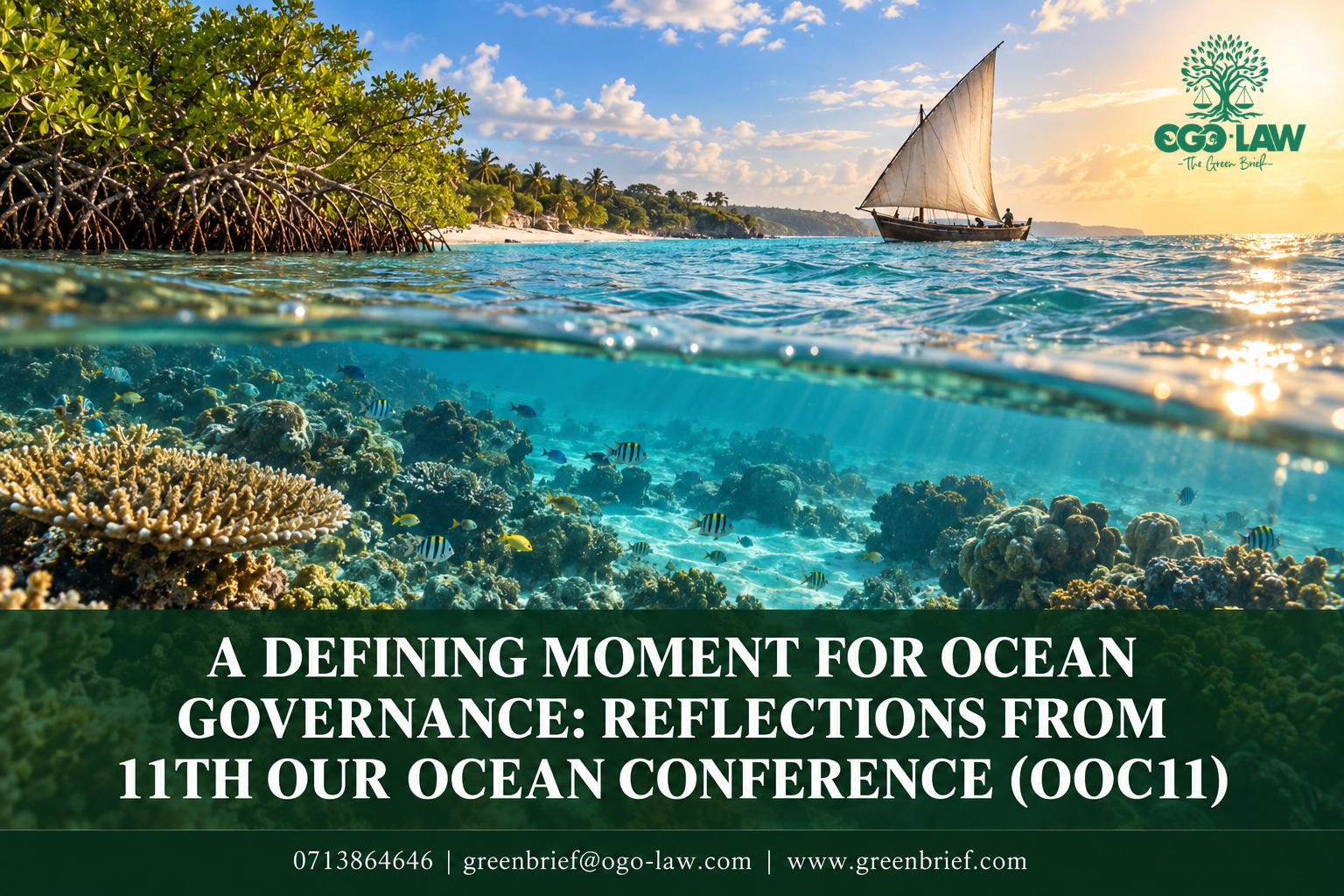

For centuries, the ocean has connected continents, powered economies, sustained communities, and shaped civilizations. Yet despite its immense importance, the world’s oceans are facing unprecedented pressure. Rising temperatures, plastic pollution, overfishing, biodiversity loss, and coastal degradation are transforming marine ecosystems at a pace that few could have imagined a generation ago. Against this backdrop, the 11th Our Ocean Conference, held in Kenya from 16 to 18 June 2026, arrived at a particularly critical moment.
The sun over Mombasa rose to greet a historic turning point for global marine conservation as the 11th Our Ocean Conference (OOC11) commenced along the Swahili Coast at the PrideInn Paradise Beach Resort. For the first time in the history of the forum, the conference was hosted on African soil, marking a symbolic and strategic shift in global ocean governance toward regions most directly affected by marine change. Under the theme “Our Ocean, Our Heritage, Our Future,” the three-day summit brought together heads of state, marine scientists, youth leaders, civil society actors, and global policymakers with a singular focus: transforming long-standing ocean commitments into measurable, enforceable action.
This was not just another international gathering. The choice of Kenya as host country reframed the geography of global environmental decision-making. For years, ocean governance has been shaped in distant capitals, often disconnected from the lived realities of coastal communities. In 2026, that centre of gravity shifted to the Western Indian Ocean, placing Africa not on the margins of the discussion, but at its core.
From the opening plenaries, delegates were confronted with a sobering global reality. More than three billion people depend directly on marine ecosystems for food security and livelihoods, while approximately 80% of all life on Earth is supported by ocean systems in one form or another. Yet despite this dependence, global protection levels remain critically low. Only 8.4% of the world’s oceans are designated as protected areas, and just 2.8% are effectively managed and enforced against destructive activity. This stark implementation gap became the anchor of the conference agenda, reinforcing the urgency behind the global “30×30” commitment to protect at least 30% of the world’s land and oceans by 2030.
Officially opening the leadership plenaries on behalf of President William Ruto, Deputy President Kithure Kindiki framed the moment as a generational obligation rather than a policy choice. He emphasized that the current generation holds a non-negotiable responsibility to return a cleaner, more resilient ocean system to the future. Kenya reinforced this message by showcasing its domestic environmental initiatives, including blue carbon projects, large-scale mangrove restoration programmes, and circular economy policies aimed at reducing marine plastic pollution. These initiatives positioned the country not only as a host, but as an active demonstration site for scalable ocean solutions.
Throughout the conference, discussions were structured around six core action pillars: Marine Protected Areas, Sustainable Fisheries, Marine Pollution, Climate Change, Maritime Security, and the Sustainable Blue Economy. Across technical sessions held in venues such as the Dodori and Shimba halls, delegates moved beyond general commitments into implementation-focused dialogue. A significant portion of the agenda centred on accelerating the High Seas Treaty, with coalitions including South Africa, Senegal, Germany, and the European Union pushing for rapid ratification and operationalization of deep-sea protection frameworks.
At the same time, coral reef protection emerged as a critical area of concern. Joint panels co-hosted by Kenya, Panama, and Zanzibar explored how fragile reef ecosystems could be safeguarded through blended finance models, particularly through investment pipelines supported by the Global Fund for Coral Reefs. These discussions reflected a growing shift toward treating conservation not only as an environmental obligation but as an investable development priority.
A defining feature of the conference was the emphasis on data, science, and technology as essential enforcement tools. The expansion of the Global Ocean Observing System (GOOS) was positioned as a central pillar in closing the monitoring gap that currently limits effective ocean governance. The Intergovernmental Oceanographic Commission (IOC) of UNESCO led calls for standardized data-sharing systems, particularly to support small-scale fisheries across Africa and the Western Indian Ocean. Without such harmonization, experts warned, efforts to combat illegal, unreported, and unregulated (IUU) fishing would remain fragmented and ineffective. Strengthening maritime domain awareness through shared satellite systems, digital tracking tools, and cross-border intelligence cooperation was therefore highlighted as a critical enforcement priority.
Climate change remained a constant underlying concern throughout the proceedings. Rising sea levels, coastal erosion, and ocean warming were repeatedly linked to increasing vulnerability in coastal economies. These pressures underscored the importance of nature-based solutions, particularly mangrove restoration and blue carbon ecosystems, which Kenya prominently showcased as part of its national approach.
As the conference progressed, attention shifted toward financing the ocean agenda. Delegates acknowledged that without predictable and sustained funding, even the most ambitious conservation frameworks risk remaining unfulfilled. The final day therefore focused heavily on blue finance mechanisms, including blue bonds, blended finance instruments, and private-sector impact investment models designed to support coastal resilience and reduce poverty in fishing communities. In parallel, the Ocean Decade Coastal Cities Blue Partnership Forum—co-hosted by UN-Habitat, was launched to create a permanent global network of coastal cities committed to translating international ocean agreements into local urban planning, zoning, and waste management systems.
Another important dimension of the conference was the growing recognition of community participation. Coastal communities, indigenous groups, youth networks, and women-led conservation initiatives were increasingly positioned not as beneficiaries of policy, but as active co-designers of ocean governance systems. This shift reflected a broader understanding that sustainable ocean management cannot succeed without local ownership and participation.
As the conference drew to a close on 18 June 2026, its significance was measured not only in speeches or declarations but in the scale of commitments recorded. Delegates departed Mombasa having pledged billions of dollars in new financing and endorsed hundreds of commitments targeting marine protection, fisheries transparency, and ecosystem restoration. The transparency of the conference’s commitment tracking mechanism reinforced its emphasis on accountability over rhetoric.
Ultimately, the 11th Our Ocean Conference marked a decisive moment in global ocean governance. By hosting the summit in Africa, the international community acknowledged that the future of the ocean cannot be shaped in isolation from the regions most directly affected by its decline. The challenge moving forward is no longer awareness, but execution. The ocean has long sustained human civilization; the test now is whether humanity can sustain the ocean in return.