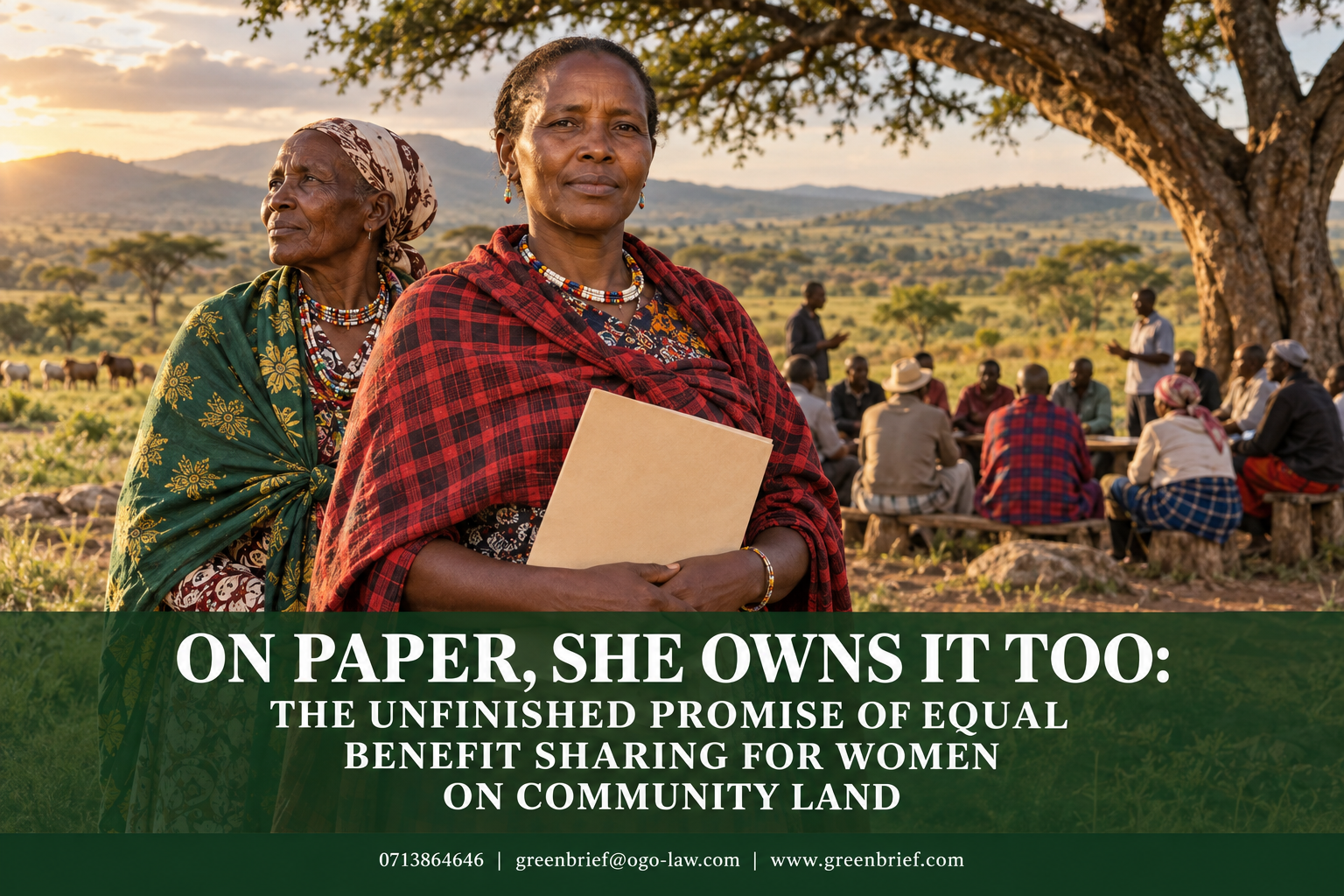

Walk into a community land meeting in many parts of rural Kenya and you will still see it: rows of men doing most of the talking, deciding how the grazing will be rotated, which company gets to lease land for a conservancy, how compensation money will be split, while the women of that same community sit at the back, present but rarely consulted. For generations, this was simply how things were. Women in most Kenyan communities could not own land in their own name. A woman’s claim to land ran through a man her father, then her husband, then, if she outlived him, sometimes her sons. If that chain broke through divorce or widowhood, so, often, did her claim to the land she had lived and worked on her whole life. This is not ancient history. It is the lived reality that many women navigating community land today grew up inside, and in many places, still do.
What makes this moment worth writing about is that the law has actually changed, in clear and specific terms. The question this piece asks and it is a real, open question, not a rhetorical one is whether that change has reached the women it was written for.
What the Law Now Actually Says
The Community Land Act, 2016 is unambiguous about who counts as a member of a community, and what that membership entitles you to. Section 30 of the Act, headed simply “Non-discrimination,” states that every member of the community has the right to equal benefit from community land, that this equality includes full and equal enjoyment of rights of use and access, and that women, men, youth, minorities, persons with disabilities, and other marginalised groups have the right to equal treatment in all dealings in community land. It goes further and makes it an explicit legal wrong for a registered community to discriminate, directly or indirectly, against any member on the basis of gender, marital status, or several other grounds.
Then comes the provision that speaks directly to the question of married women: section 30(5) states, in plain terms, that every man or woman married to a member of the community gains automatic membership of that community, and that this membership continues until a legal divorce and the woman remarries, or until she remarries after the death of a spouse. In other words, the law does not treat a married in woman as a guest, a dependent, or a temporary resident on her husband’s land. She is a member of that community in her own right, with the same legal standing as anyone born into it, for as long as that marriage subsists or until she remarries elsewhere.
Being a member is not a symbolic label. The Act ties concrete entitlements to it. Section 15 establishes the community assembly as consisting of all adult members of the community, meaning married women are legally part of the body that makes decisions over community land, not spectators to it. Where community land generates income, whether through leasing to an investor, a conservation partnership, or any commercial use, section 36 requires that any such agreement be reached only after a free, open, consultative process, and that it be approved by two-thirds of the adult members present at a community assembly meeting called for that purpose, a meeting married women are legally entitled to attend, speak at, and vote in, on exactly the same footing as men. Section 35 adds that natural resources on community land must be managed for the benefit of the whole community, including future generations, on the basis of equitable sharing of the benefits that accrue from them. There is no clause anywhere in this framework that says “except women,” or “except women who married into the community.”
This statutory position rests on an even stronger constitutional foundation. Article 27 of the Constitution guarantees every person equality before the law and the right to equal protection and equal benefit of the law, and states specifically that women and men have the right to equal treatment, including equal opportunities in political, economic, cultural, and social spheres. Article 27(8) requires that no more than two-thirds of the members of any elective or appointive body be of the same gender a rule that election guidelines for Community Land Management Committees have applied directly, meaning that when a community gathers to elect the seven to fifteen members of its Community Land Management Committee under section 15, that committee cannot lawfully be made up almost entirely of men. Article 60, setting out the principles of Kenya’s land policy, goes further still and requires the elimination of gender discrimination in law, customs, and practices related to land and property. That is not an incidental mention. It is a constitutional instruction that customary practices excluding women from land decisions are exactly what the new order was built to dismantle.
So Is It Actually Happening?
Here is the honest answer, and it is the one that matters most: the law is far ahead of the practice.
Legal recognition and lived reality are two different things, and the gap between them is where most women on community land currently find themselves. Community Land Management Committees are still, in a great many registered communities, overwhelmingly male, despite the two-thirds gender principle that is supposed to govern how they are elected. Women married into a community are still, in practice, sometimes treated by elders and by their own in-laws as outsiders whose voice carries less weight in decisions about grazing, leasing, or benefit-sharing, even though section 30(5) says otherwise in the clearest possible terms. Benefit-sharing arrangements for conservancies, carbon projects, and other investments on community land are frequently negotiated and distributed through channels clan elders, group ranch committees, men that were never restructured to guarantee women an equal seat, even where the underlying law now requires exactly that.
Part of the problem is awareness. Organisations working directly with pastoralist and agro-pastoralist communities on land rights consistently find that many women do not know that the Community Land Act gives them these specific entitlements, the automatic membership on marriage, the right to attend and vote in the community assembly, the right to stand for election to the management committee, the right to an equal share of any benefit the land produces. You cannot exercise a right you don’t know you have, and in communities where legal literacy is low and where customary practice still carries enormous social weight, the written law can sit almost entirely unused alongside the older, unwritten rules that continue to govern daily life.
This is precisely why this remains an open, active question rather than a settled achievement. The Community Land Act did something historically significant by naming women as full members with equal entitlement to community land and its benefits. It did not, on its own, dismantle decades of custom that treated women’s claims to land as conditional and secondary. That second task, turning a legal right into a lived one is still very much in progress, and it depends heavily on whether women themselves know the law, and whether communities are willing to be held to it.
Why Women Belong at the Table, Not Just on the Membership List
This is not only a fairness argument, though it would be a sufficient one on its own. Women in most Kenyan pastoralist and agricultural communities are the ones who walk furthest for water, who know which grazing areas recover fastest after drought, who manage the household economy that absorbs the first shock when a conservation project fails to deliver what it promised, and who often carry as much practical, on the ground knowledge of the land as any elder. Leaving them out of the Community Land Management Committee, out of the community assembly’s real decision-making, or off the governing boards of the conservancies increasingly being built on community land, does not just deny women something they are legally owed. It removes a source of judgment and knowledge that communities need if these projects are going to be managed well and to last.
The law already gives women the standing to be in that room. Section 15 makes them part of the assembly that elects the management committee. The two-thirds gender principle in Article 27(8) means that committee is not lawfully constituted if it excludes them. Section 30 says the benefits arising from the land are theirs by right, not by favour. What remains is making sure this is understood and insisted upon inside the communities themselves by the women who are entitled to it, and by the elders, chiefs, county officials, and conservation organisations who currently decide, in practice, whether that entitlement is honoured or quietly set aside.
What This Means in Practice
For any woman married into a community holding registered or registering community land: you are a member of that community in your own right from the date of that marriage, for as long as it lasts. You are entitled to attend and vote at community assembly meetings. You are entitled to stand for election to the Community Land Management Committee. You are entitled to an equal share of whatever benefit grazing, lease income, conservation revenue, compensation that land generates, on exactly the same basis as any man in that community. None of this depends on your husband’s permission, your in-laws’ approval, or the community’s custom on the matter. It depends only on the law, which has already settled the question.