
For most of Kenya’s modern history, wildlife and the people who lived alongside it were treated as enemies of each other in the eyes of the law. If you were a pastoralist, a hunter-gatherer, or a forest dweller, the same law that fenced off a national park to protect a lion or an elephant usually did so by fencing you out. Today, something genuinely different is happening. In pockets across the country, it is not government agencies or foreign conservation groups leading the way, but the communities themselves Maasai, Samburu, Taita, and others managing the very wildlife and forests their grandparents were once evicted to make room for. The reason this shift is possible now, and wasn’t before, comes down to one thing: land tenure.
To understand how big this change is, it helps to remember how things used to work. Colonial-era law never recognised customary land rights as real ownership. Land held under African custom was treated as something less than property available to be declared Crown Land, fenced into a game reserve, or gazetted as a forest, all without the consent of the people living on it. Independence did not immediately undo this. For decades after 1963, communities occupying land under customary tenure still had no secure legal claim to it, which meant that “conservation” could still mean eviction, because the law didn’t recognise a community’s right to say no.
A Law Built to Take Land, Now Rewritten to Return It
The 2010 Constitution broke with that history in a very deliberate way. Article 63 does something no previous Kenyan constitution ever did: it names community land as its own category of land ownership, standing legally alongside public and private land, and it recognises land held under customary tenure as land legitimately owned by that community. This is not a symbolic gesture. It is a right of ownership, with the same constitutional protection against arbitrary taking that applies to any title deed. Article 61 sets out this three-way classification of all land in Kenya public, private, and community and Article 60 requires that all land be held, used, and managed in a way that is equitable, secure, and sustainable.
Parliament gave that constitutional promise practical teeth through the Community Land Act of 2016. Once a community formally registers its land under this Act, that land is legally theirs, managed by a community assembly and an elected management committee, and it cannot be taken away except in the same way any private landowner’s property can be, for a clear public purpose, following the law, and with prompt, fair compensation. Crucially, the Act also requires that when the natural resources on that land are put to commercial use, whether that’s grazing, tourism, or conservation, the benefits arising from it must be shared with the community that owns the land.
This is the quiet legal revolution underneath everything else in this story. When a community holds secure, recognised title to its own land, conservation stops being something done to them and starts becoming something they can choose to do, on their own terms, as landowners exercising their own rights.
The Courts Are Starting to Push Back Against the Old Model
Recognising rights on paper is one thing. Making the state honour them is another, and this is where Kenyan and regional courts have started to matter enormously.
The clearest example is the Ogiek of the Mau Forest, a community of forest-dwelling hunter-gatherers who were evicted from their ancestral home again and again over the decades, usually in the name of forest conservation. In 2017, the African Court on Human and Peoples’ Rights ruled that Kenya had violated the Ogiek’s rights to property, culture, religion, and natural resources by repeatedly evicting them, and in 2022 it went further, ordering the government to restore their ancestral land, pay compensation, and recognise their right to be consulted and to give or withhold consent before any future conservation or development project touches their land. In reaching that decision, the Court drew directly on the United Nations Declaration on the Rights of Indigenous Peoples, particularly its recognition that indigenous peoples have the right to the lands they have traditionally owned and the right not to be forcibly removed from them without their free, prior, and informed consent. That declaration isn’t a treaty Kenya can be sued under directly, but it has become one of the most important tools advocates and courts now reach for to argue that old style conservation evictions have no place in modern law.
The same argument is being tested inside Kenya’s own courts. In January 2025, Kenya’s Environment and Land Court ruled that wildlife conservancies established by the Northern Rangelands Trust in Isiolo County’s Cherab and Chari wards were unconstitutional, because they had been set up on unregistered community land without the public participation the Constitution requires. This ruling matters because it shows Kenyan courts are willing to strike down even well-known, internationally funded conservation models when they bypass a community’s land rights proof that the legal protections built since 2010 are not just words, but standards the courts will actually enforce, against powerful conservation actors as well as against the state.
Community-Based Natural Resource Management: The Law Is Already There
Once you accept that communities own their land, the next legal question is obvious: who should manage the wildlife, forests, and water on it? Kenyan law increasingly answers: the community itself, because nobody understands that land better.
The Wildlife Conservation and Management Act of 2013 states this as a guiding principle outright wildlife conservation is recognised as a legitimate form of land use in its own right, on public, private, and community land alike, and the people who bear the cost of living alongside wildlife are entitled to a fair share of the benefits it generates. The Act allows landowners and communities to formally establish their own wildlife conservancies and sanctuaries, gives county wildlife committees a role in overseeing compensation for problems like crop damage or livestock loss caused by wild animals, and requires that before anyone can commercially explore a community’s biological resources, they must first obtain that community’s consent and agree with them on how any benefits will be shared.
The Forest Conservation and Management Act of 2016 does something similar for public forests, allowing communities to form registered Community Forest Associations that participate directly in managing state and county forests under jointly agreed management plans, rather than being kept out as trespassers. And the older Environmental Management and Co-ordination Act requires public participation before most projects affecting the environment can proceed at all, giving communities a legal foothold in decisions that used to be made entirely without them.
Put together, this is the legal architecture of what’s often called community-based natural resource management: instead of a government agency or an outside organisation deciding what happens to the wildlife and forests on a landscape, the people who actually live there, and who often carry generations of accumulated knowledge about how that land behaves through drought, migration, and season, are placed at the centre of managing and restoring it.
What This Looks Like on the Ground
None of this is theoretical. Kenya now has some of the most striking real world examples anywhere in Africa of secure land tenure turning into community led conservation success.
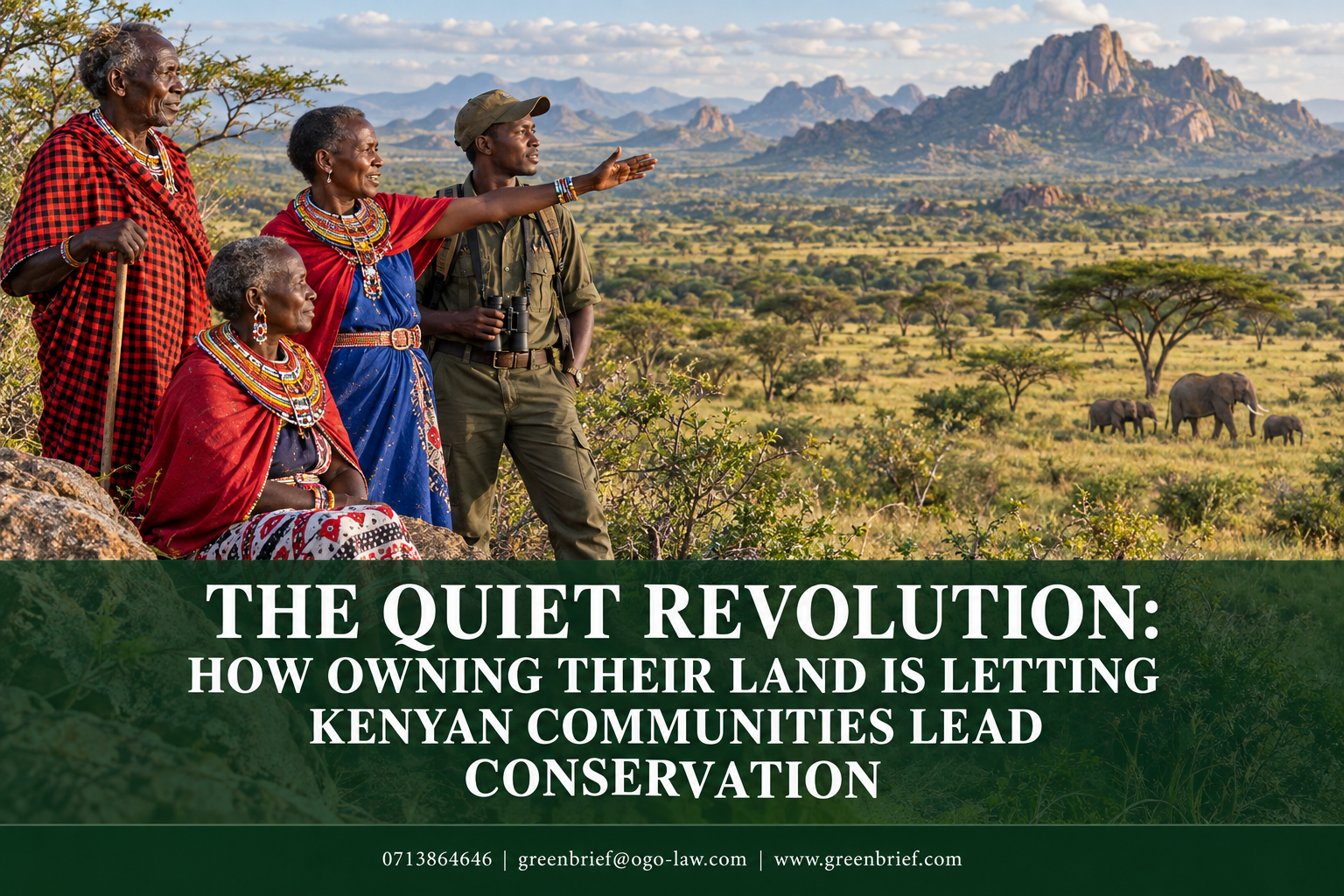
In Samburu County, the Namunyak Community Conservancy, owned and governed by the Samburu people themselves is home to Reteti Elephant Sanctuary, established in 2016 as the first elephant sanctuary in Africa to be entirely owned and run by an indigenous community. Local keepers, trained and employed from the surrounding villages, rescue and rehabilitate orphaned elephant calves in a conservancy that is also home to one of the largest elephant populations outside Kenya’s national parks. It exists because the Samburu hold recognised rights to that land and chose, on their own terms, to use it this way.
In Laikipia, the Il Ngwesi Group Ranch nearly, owned by close to 7,000 Maasai pastoralists runs Kenya’s only community owned rhino sanctuary and the country’s first community owned eco-lodge, opened in the 1990s. Every shilling of profit is ploughed back into the community’s own schools, water supplies, and cattle dips. Wildlife numbers on the ranch have grown since the community took over its management, because protecting that wildlife now pays the community directly, rather than being an obligation imposed on it from outside.
Across northern and coastal Kenya, dozens of community conservancies now operate under the umbrella of the Northern Rangelands Trust, together governing millions of acres of rangeland that host elephants, lions, and black rhino, run by the pastoralist communities who live there. And in the drylands between Tsavo East and Tsavo West, the Kasigau Corridor project shows what secure land tenure makes possible even in newer areas like carbon finance: because the Taita landowners in that corridor held clear, provable title to their land through community owned trusts, they were able to enter one of the world’s first REDD+ forest carbon projects, generating income for tens of thousands of local people while protecting a critical wildlife corridor between the two national parks.
Why Communities Belong at the Centre
Every one of these examples rests on the same foundation: land tenure came first, and community-led conservation followed. That order matters. A community that merely hosts someone else’s conservation project has little reason to protect it and every reason to resent it, especially if that community’s parents or grandparents were displaced by an earlier version of the same idea. A community that owns the land, holds the decision-making power over it, and receives a fair, legally recognised share of what it generates has every reason to protect it for the long term, because it is protecting its own asset and its own children’s inheritance.
This is also where indigenous knowledge earns its proper place in the law, rather than being treated as folklore on the sidelines of a scientific process. Communities who have lived on a piece of land for generations know its seasonal rhythms, its water points, its wildlife corridors, and its early warning signs of stress in a way no outside expert visiting for a few weeks ever fully can. Kenyan law, particularly through the Community Land Act’s requirement of community-led management and the Wildlife Conservation and Management Act’s recognition of community consent, has begun to make room for that knowledge to actually drive decisions, instead of being consulted as an afterthought.
The revolution now under way in Kenya’s conservation landscape isn’t really about wildlife policy at all. It is about property law. Once the Constitution and the courts made secure land tenure a real, enforceable right for indigenous and rural communities, conservation stopped being something imposed on them from a colonial-era playbook, and started becoming something they could choose, shape, and profit from as owners. The unfinished work as the recent ruling against conservancies built on unregistered land in Isiolo shows, is making sure every community gets that secure title first, before anyone asks them to sign an agreement about what happens on it next.