
Introduction
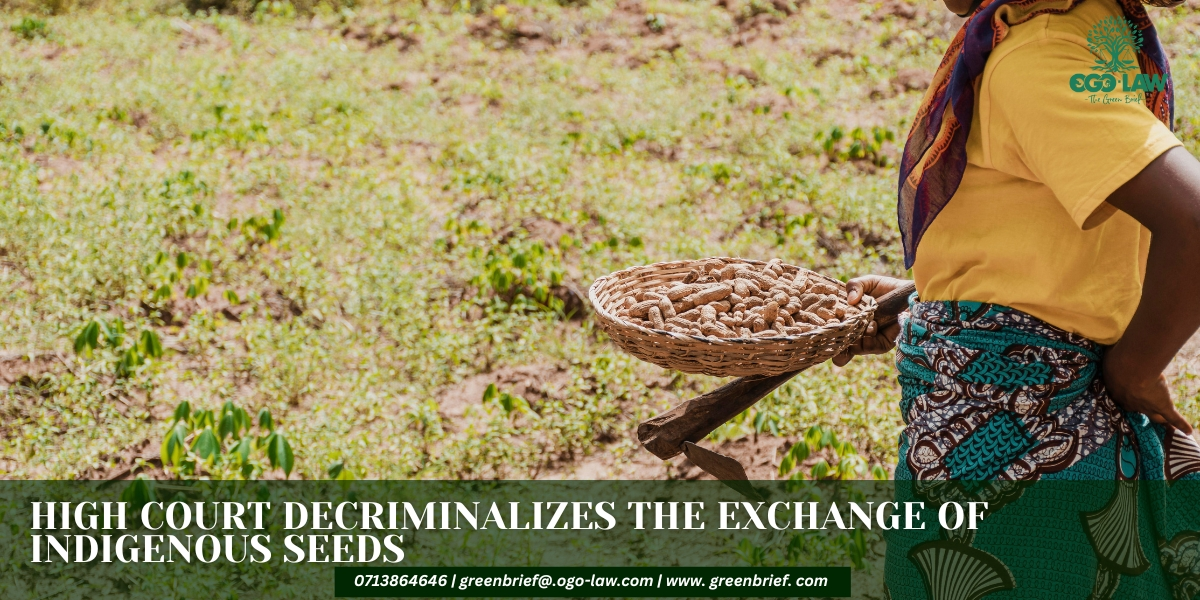
On 27th November 2025, the High Court of Kenya at Machakos presided over by Justice Rhoda Rutto decriminalized the old-age practice of selling, sharing and exchanging of unregistered, uncertified and protected seeds in Kenya in the case of Wathome & 14 others v Kenya Plant Health Inspectorate Service & another; Greenpeace Environmental Kenya & 2 others (Interested Parties) [2025] KEHC 18166 (KLR). The Petition was filed in 2022 by farmers from the Seed Savers Network Kenya (Petitioners) where they challenged the constitutionality of section 3D(1), 8(1), 8A(1), 10(4)(c, d, e, f and g), 20(1E) of the Seeds and Plant Varieties Act Cap. 326 and Rules 6, 9(5), 16, 19 and the fifth schedule of the Seeds and Plant Varieties (Seeds) Regulations Legal Notice 220 of 2016.
Legal Analysis
Seed Savers Network Kenya (Petitioners) submissions
The Petitioners submitted that by criminalizing the selling, sharing and exchanging of unregistered, uncertified and protected seeds in Kenya:-
1. It denied farmers the right to protect traditional knowledge, share benefits from plant genetic resources and participate in national decision-making on conservation and sustainable use of plant genetic resources for food and agriculture, thus contravening the International Treaty on Plant Genetic Resources for Food and Agriculture.
2. It violated the TRIPS Agreement and the UN Declaration on the Rights of Peasants (UNDROP), which guarantee a farmer’s right to save, use, exchange and sell farm-saved seed/propagating material.
3. It denied farmers the right to be recognized and protected so that they can continue to contribute to conserving and sustainably using plant genetic resources as well as the right to save, exchange and use part of the seed from their first crop for subsequent crops.
They also asserted that the Seeds and Plant Varieties Act Cap. 326 does not define what actions would attract criminal penalties and that the mandatory registration and certification requirements ignore the existence of indigenous seeds and the informal exchange systems used by small-scale farmers. Additionally, by granting excessive powers to inspectors, it allowed for arbitrary searches and seizures that violate constitutional rights to privacy, property, and fair administrative action.
Beyond procedural issues, the petitioners submitted that the Seeds and Plant Varieties Act Cap. 326 creates unreasonable economic barriers, thus threatening food security. They highlighted that the high costs of registration of 75,000 Kenya Shillings for seed merchants discriminated against small-scale farmers and consequently violated the right to equality and the right to food under Articles 27 and 43 of the Constitution.
Kenya Plant Health Inspectorate Service (Respondents) submissions
On the other hand, the Attorney General and the Kenya Plant Health Inspectorate Service defended the amendments that criminalized indigenous seeds by stating that:-
1. The Seeds and Plant Varieties Act Cap. 326 is a necessary regulatory framework designed to protect farmers and consumers from low-quality seeds, pests, and diseases.
2. The registration and certification requirements are reasonable limitations aimed at ensuring food security and protecting the intellectual property of breeders, as permitted by both the Constitution and international treaties.
3. The Act does not criminalize indigenous seeds but rather includes them under its protective umbrella, noting that Section 27A specifically provides for the conservation of plant genetic resources.
Court decision
The Court held that:-
1. The registration, regulation and requirements for registration and certification would limit the farmers’ cultural rights to save, share, and exchange indigenous seeds and materials,
2. The stringent requirement for registration as a seed merchant and the registration fees of 75,000 Kenya Shillings and the annual renewal fees of 10,000 Kenya Shillings put the petitioners and small-scale farmers at a disadvantage when compared with large-scale farmers.
3. Section 3D(1) as read with Regulation 21 of the Seeds and Plant Varieties Act fails to provide an opportunity to an aggrieved owner of the seized property to contest the seizure or an opportunity to challenge any lack of procedural fairness and is therefore arbitrary in nature and in violation of the right to privacy under Article 31(a) of the Constitution of Kenya.
4. The exclusion of the requirement of the inspector to give written reasons for the decision to seize and detain any seeds and seed processing facilities violates the right to fair administrative action protected under Article 47 of the Constitution of Kenya.
5. To allow the seizure of the uncertified seeds is to enact a law that arbitrarily deprives the farmers of their right to property under Article 40(2) of the Constitution of Kenya.
In conclusion the Court found Section 3D(1), 8(1), 8A(1), 10(4)(c, d, e, f and g), 20(1E) of the Seeds and Plant Varieties Act Cap. 326 and Rules 6, 9(5), 16, 19 and the fifth schedule of the Seeds and Plant Varieties (Seeds) Regulations Legal Notice 220 of 2016 unconstitutional for violating Cultural rights on ownership of indigenous seeds and plant varieties, right to privacy, right to equality and freedom from discrimination, right to property and the right to fair administrative action.
Seed Sovereignty in Kenya: High Court Decision
The tension between uniform commercial seed systems and informal seed systems is one of the most significant battles in modern agriculture; that is why this judgment is a major win for small-scale farmers. The judgment not only protects small-scale farmers but also acknowledges that agricultural biodiversity is a shared heritage, thus restoring balance in an area that is further tilting in favour of a ‘one-size-fits-all’ seed system.
In addition, this decision advances the concept of seed sovereignty, which promotes the right to sell, share and exchange indigenous seeds as opposed to commercial seed systems where only a handful of people control the seeds. It emphasizes that while innovation can be patented, thus creating a uniform seed system, old-age practices of exchanging indigenous seeds are a cultural heritage that continues to be living repositories of genetic diversity. Consequently, the decision reminds us that as policymakers, there is a need to protect seed sovereignty by creating a balance between formal and informal seed systems. This ensures there is a decentralized seed system, thus spreading the risks and ultimately guaranteeing food security at a time when the world is grappling with climate change.
Selling, sharing and exchanging of unregistered, uncertified and protected seeds in Kenya decriminalized.
Mandatory seed registration and high registration fees unconstitutionally infringes on small scale farmers’ cultural rights regarding indigenous seeds.
Arbitrary searches and seizures violate constitutional rights to privacy, property and fair administrative action.