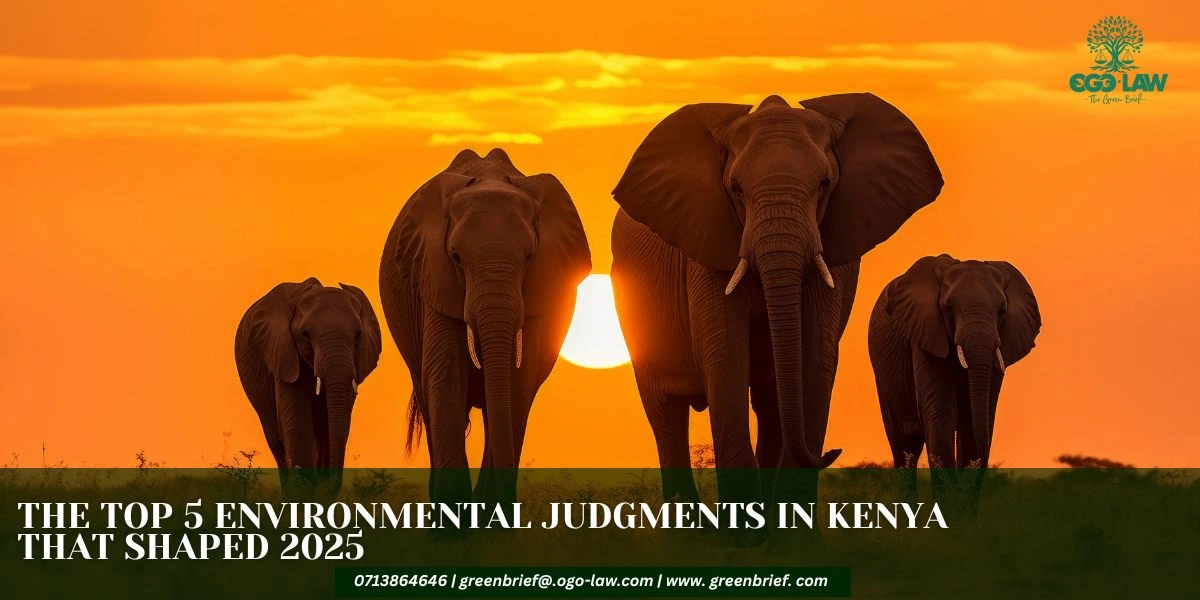

In 2025, Kenya’s courts took a bold environmental turn, delivering landmark rulings that reshaped land use, protected wildlife corridors, and enforced real climate accountability, proving the gavel truly went green. This year will be remembered as the year Kenya’s courts took an unmistakably bold stance on environmental protection.
For years, environmental governance has relied heavily on policy debates, county decisions, and community advocacy, but this year, the judiciary became the unexpected hero in shaping land use, wildlife protection, and climate accountability across the country. From rangelands threatened by subdivision to wetlands squeezed by rapid urban expansion, judges delivered rulings that clarified the law, challenged poor governance, and reminded both public and private institutions that environmental rights in Kenya are constitutional guarantees, not privileges.
As environmental pressures intensified, from climate impacts to development conflicts, five landmark decisions emerged as defining moments. These judgments did not simply resolve disputes; they recalibrated the direction of Kenya’s environmental law, setting new standards for NEMA compliance, climate litigation, wildlife protection, and sustainable land management. Below is the story of how the courts quietly, firmly, and at times dramatically, steered Kenya toward a future where the law protects nature as fiercely as communities do.
Rangeland Subdivision Put on Hold in Kenya
The year opened with one of the most significant rulings in recent memory: a halt to the subdivision of ecologically fragile rangelands. For decades, communal lands in regions like Loita, Kajiado, Samburu, and Laikipia have faced intense pressure from privatization and speculative buying. Fragmentation has not only undermined pastoral mobility but also disrupted critical wildlife landscapes.
In early 2025, the Environment and Land Court stepped in decisively. Citing Article 69 of the Constitution and the precautionary principle under EMCA, the court blocked the issuance of new titles pending a comprehensive assessment of environmental and social impacts. In effect, the judiciary declared that land use changes must consider ecosystem integrity, not just administrative paperwork.
This ruling instantly became a reference point for land governance. Counties now face heightened scrutiny when approving subdivisions, and land control boards have been pushed into a new era of accountability. For conservationists, it was a long-awaited affirmation that Kenya’s rangelands are environmental assets, not blank canvases for uncontrolled fencing.
Wildlife Corridors Recognized as Public Interest Assets in Kenya
Perhaps the most celebrated decision of 2025 was the court’s recognition of wildlife corridors as public interest ecological assets. In a country where human-wildlife conflict has intensified, this judgment was a breath of hope and a clear legal statement.
The case involved a corridor historically used by elephants, lions, and other wildlife, now under pressure from fencing, real estate developments, and agricultural expansion. The court ruled that such corridors, once scientifically established, hold legal significance even when they traverse private land. The Wildlife Conservation and Management Act, the judgment stated, must be interpreted with Kenya’s constitutional duty to protect biodiversity.
This decision radically shifts how development will proceed in wildlife landscapes such as the Naivasha-Mai Mahiu belt and the Amboseli ecosystem. Developers can no longer plead ignorance or dismiss corridor data. Instead, they must demonstrate NEMA compliance, incorporate mitigation plans, and respect the ecological function of these migratory routes. For wildlife, it is a victory that may shape the country’s conservation narrative for decades.
Climate Accountability Takes Center Stage in Kenya
For years, Kenya’s climate commitments have lived in policy documents, international speeches, and government reports. But in 2025, the High Court transformed those commitments into actionable, enforceable obligations. In a case filed by civil society actors, the court ordered key state agencies to publicly report on greenhouse gas mitigation, adaptation measures, and progress toward Kenya’s Nationally Determined Contributions.
This ruling was monumental. It marked the first time that climate obligations under the Paris Agreement were judicially enforced in Kenya. Agencies are no longer free to make aspirational climate statements; they must provide measurable, time-bound evidence.
The judgment is already influencing budget allocations, inter-agency coordination, and climate governance. More importantly, it positions Kenya as a continental leader in climate litigation, demonstrating that courts can, and will, hold governments accountable for the climate promises they make.
NEMA Compliance Reimagined Through Industrial Licensing
Out of all the year’s cases, few struck as close to the heart of environmental governance as the ruling that revoked an industrial license for failing to implement EIA conditions. Courts have occasionally reprimanded non-compliant developers in the past, but 2025 was different: the judge made it clear that an Environmental Impact Assessment is not a formality, but a binding framework with real accountability.
The ruling revealed a troubling pattern: mitigation measures approved by NEMA often remain theoretical once projects begin operation. In this case, the court stated that ignoring EIA conditions was not only illegal but posed real harm to nearby communities and ecosystems. The decision served as a wake-up call for industries, from quarries to agro-processors, many of whom have now rushed to update their compliance audits and environmental management plans.
In the broader landscape of Kenya environmental law, this case reasserted the principle that development cannot proceed at the expense of environmental safety, and that NEMA has a legal, rather than symbolic, role in enforcement.
Wetlands Protected Against Urban Expansion
Rounding out the year’s most influential judgments was a case involving a wetland under threat from a high-profile mixed-use development. Urbanization continues to reshape Nairobi, Kisumu, and Nakuru, often at the expense of wetlands that serve as natural flood buffers and biodiversity hotspots.
In a rare and inspiring victory, the community petitioning the case prevailed. The court ruled that wetlands are protected ecosystems under EMCA and the Constitution, and that county authorities must integrate strategic environmental assessments when approving large-scale developments. The judgment emphasized that short-term economic interests cannot override the long-term ecological value of wetlands.
This ruling has already influenced multiple county planning departments, who now face heightened pressure to justify development in ecologically sensitive zones. At a time when climate-driven flooding is worsening, the decision could not have come at a better moment.
What 2025’s Judgments Mean for Kenya’s Environmental Future
Taken together, these five judgments reveal a judiciary determined to uphold environmental rights with clarity and courage. Whether the issue is climate compliance, wildlife migration, NEMA enforcement, or land governance, courts have signaled a new era where environmental law is not ornamental; it is operational.
Developers will need stronger compliance cultures. Counties will be compelled to integrate science into planning. State agencies will face growing pressure to report transparently on climate actions. Communities will increasingly recognize the power they hold when they use the law to defend their environment. For Kenya, 2025 was not just a year of legal decisions.
It was a year of environmental direction.